In short: An Industrial IoT platform, also called Industrial Internet of Things platform or IIoT platform, is software that connects machines, sensors and production systems with IT applications. It reads data in the protocols of the shop floor, adds context and makes it available to MES, ERP, analytics, cloud services and AI applications in near real time. Industrial IoT software of this kind runs close to production, on premises, at the edge or in the cloud, and forms the shared data foundation for use cases across lines and plants.
Jump to: Terms · Architecture · Key features · Platform types · Benefits · Challenges · How to choose · Case study · Examples · Implementation · FAQ
The term IoT platform covers a wide field. A smart home hub, a fleet management service and a factory system can all be called IoT platforms. What they share is the basic task of connecting devices, collecting their data and making it usable in applications. An Industrial IoT platform does this under the conditions of production: machines that run for decades, controllers from many vendors, shift operation around the clock and strict requirements for availability and security.
Industrial IoT describes the networking of machines, sensors and systems in industry as a whole. The Industrial IoT platform is the software layer that makes this network manageable. The table shows where the differences lie.
| IoT platform (general) | Industrial IoT platform | |
|---|---|---|
| Typical devices | Consumer devices, connected products, trackers and smart meters | PLCs, CNC machines, robots, sensors and systems such as MES and ERP |
| Protocols | Mostly MQTT, HTTP and vendor-specific cloud APIs | OPC UA, Modbus, S7, MQTT and many proprietary machine protocols |
| Where it runs | Usually as a cloud service | On premises, at the edge, in the cloud or as a hybrid |
| Lifecycle of devices | A few years, with regular updates | Often decades, with controllers that are rarely changed |
| Key requirements | Scaling to very large numbers of similar devices | Stable operation during running production, IT/OT security and data sovereignty |
Related terms often appear as synonyms. Industrial Internet platform is an older term from the early days of the Industrial Internet of Things. IIoT software and Industrial IoT software usually refer to the same category, sometimes also to individual applications that run on top of a platform.
Most plants have grown over decades. A typical production hall runs machines from many vendors and several controller generations, each with its own interface. Shop floor data exists in large quantities, but it sits in controllers, local databases and isolated SCADA systems. Every new use case therefore begins with the same question of how to get to the data.
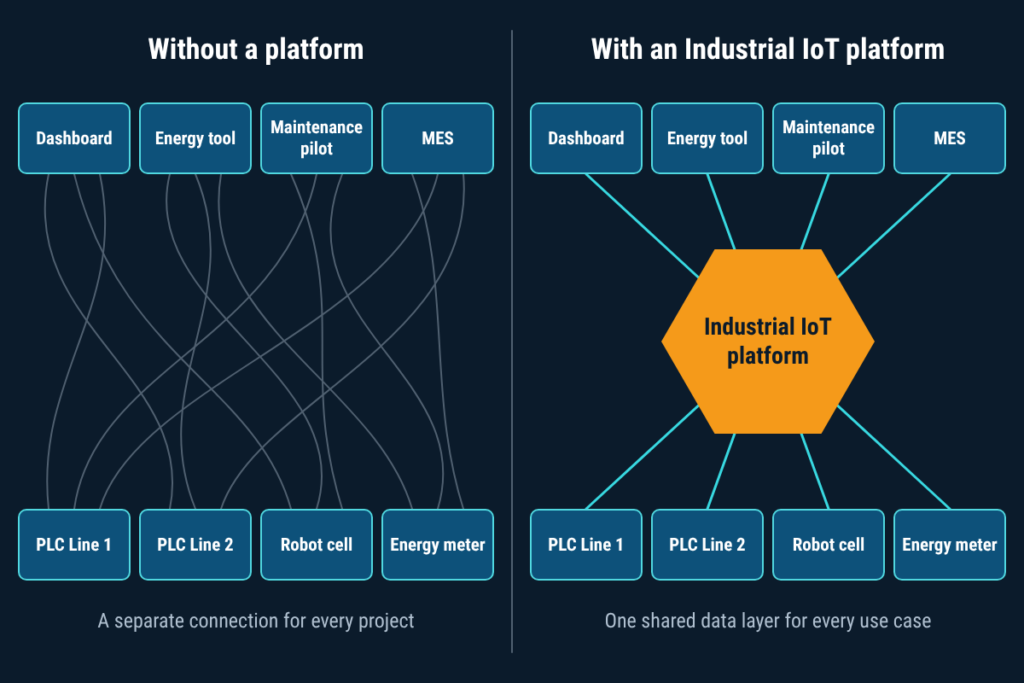
In many companies the answer has been a separate point-to-point connection for each project. A dashboard reads the controller directly, the energy tool brings its own gateway and the maintenance pilot uses a separate cloud connector. Each of these solutions works on one line. The difficulties begin with the rollout to further lines and plants, because every connection has to be built, secured and maintained again. Over time a labyrinth of integrations grows that few people fully understand and that slows down every change.
The market for IoT platforms reflects this experience. According to an analysis by IoT Analytics from September 2025, the number of IoT platforms rose to more than 620 by 2019 before the market consolidated. Among the reasons, the analysts name the complexity of brownfield environments and legacy protocols, which made the promised simple onboarding of machines difficult. Since then, the value has shifted toward data management and industrial DataOps.
Applications in production need a reliable data foundation first. An Industrial IoT platform provides it once, for every use case that follows.
Much like a nervous system, an Industrial IoT platform carries signals from the machines to the places where decisions are made. Its architecture can be described in five layers. Not every product covers all of them, which makes the layers a useful basis for comparing offers.
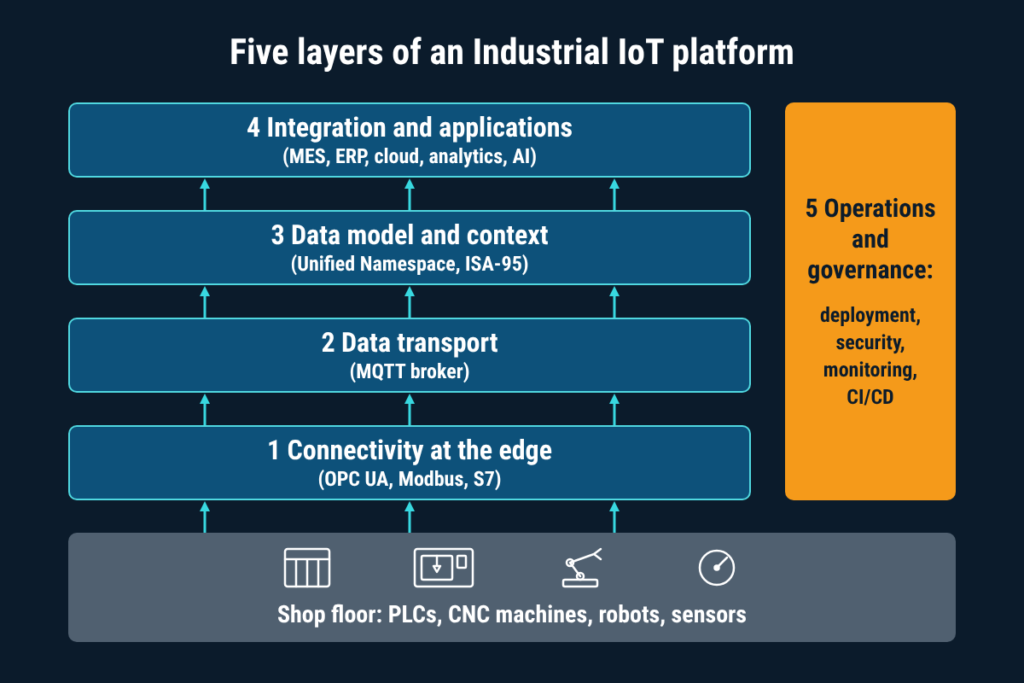
Protocol adapters read controllers, sensors and systems in their native protocols, for example OPC UA, Modbus or Siemens S7. They run close to the machines on edge computing hardware or on servers in the plant network. The machines and their PLC programs remain unchanged.
The collected values are published to a central MQTT broker. MQTT follows the publish/subscribe principle, so producers and consumers of data no longer need to know each other. New applications subscribe to existing data streams without touching the source. This decoupling is the basis of an event-driven architecture.
A raw value such as a register address carries little meaning on its own. The platform maps it to understandable names, units and asset structures, often based on the ISA-95 hierarchy of enterprise, site, area and line. When this structure is shared by all systems, it becomes a Unified Namespace, the single place where the current state of production can be found.
On top of the structured data, the platform connects the IT side: MES, ERP, time series databases, cloud services, dashboards and Industrial AI models. Data flows in both directions, for example when an order from the ERP is passed on to the machine.
The fifth layer decides whether the platform still works after several years and many plants. It covers deployment on premises, at the edge or in the cloud, user and access rights, certificates, monitoring and updates. Modern platforms describe their configuration as code (Infrastructure as Code) and run on container platforms such as Kubernetes.
Regardless of the vendor, a few features separate a production-ready Industrial IoT platform from a pilot setup.
The platform collects machine states and process values continuously and in near real time. It supports the diverse industrial protocols of an installed base and secures every connection with encryption such as TLS and mTLS, certificate-based authentication and fine-grained access rights. OT security requirements are part of the architecture from the start.
Aggregating, normalizing and contextualizing data is the core of the platform. It turns raw signals into information that applications can use directly, buffers data during network outages and forwards it to databases and analytics tools. This is where an Industrial IoT platform becomes an industrial data platform.
An Industrial IoT platform connects operational technology (OT) and IT through open standards and interfaces. MQTT, OPC UA and REST make data accessible across departments without each team building its own connection. Production, maintenance, quality and IT work with the same data.
Beyond data management, the platform supports the development and deployment of applications at the edge and in the cloud. Configurations are versioned, tested and rolled out automatically through pipelines for continuous integration and delivery (CI/CD). This continuous development lets plants introduce changes in small steps during running production, without waiting for the next maintenance window.
In architecture discussions, several terms describe overlapping parts of the same idea. The comparison helps to place them.
| Term | What it is | Relation to the Industrial IoT platform |
|---|---|---|
| Industrial IoT platform | Software that connects, structures and distributes industrial data and supports the operation of applications | The umbrella term for the complete layer between machines and applications |
| Connectivity layer | The part that reads machines and systems in their protocols and makes their data available in a uniform way | Layers 1 and 2 of an Industrial IoT platform and the prerequisite for everything else |
| Unified Namespace | An architecture concept: a shared, event-driven data structure in which every system publishes and finds the current state of production | Layer 3. An Industrial IoT platform can provide the Unified Namespace and keep it up to date |
| (Factory) Data Hub | A central hub that collects, harmonizes and distributes the data of one or more factories | Often used synonymously for an Industrial IoT platform focused on data infrastructure, see Data Hub and Factory Data Hub |
| Cloud IoT service | Managed services from cloud providers for device management, data ingestion and storage | Can be part of the architecture. In brownfield plants it needs an edge layer that connects the machines |
In practice, all these terms point to one goal: a data layer on which every application can build. The name a vendor uses matters less than the question of which of the five layers its product actually covers.
The market has sorted itself into a few types. According to IoT Analytics, the five largest hyperscalers held 60 percent of the market for vendor-agnostic IoT platforms in 2024, up from 39 percent in 2020. At the same time, specialized offerings for industrial data and edge computing have gained importance.
| Type | Typical strengths | What to check |
|---|---|---|
| Cloud IoT services | Scalable storage and computing, many managed services, a good fit for connected products | How machines in the plant are connected, latency, ongoing cloud costs and where the data is stored |
| Application enablement and end-to-end platforms | Dashboards, apps and analytics from a single source and a quick start for a first use case | Dependence on one vendor and how easily data can be used outside the platform |
| Industrial connectivity and data platforms | Vendor-neutral connection of the installed base, a shared data model and operation on premises and at the edge | Breadth of the protocol portfolio, scaling across plants and interfaces to the applications of your choice |
| Analytics and AI platforms | Evaluation, machine learning and visualization of production data | Where the data comes from and how it is kept current and consistent |
Some companies build their own platform from open-source components such as an MQTT broker, a flow tool and a time series database. This offers maximum freedom and works well for a pilot. The effort lies in operation, because security updates, high availability, certificates and documentation for every plant have to be provided by the company’s own team for years. A purchased platform takes over this effort and should still leave the data and the interfaces in the company’s hands.
The benefit of a platform grows with every additional use case, because the data foundation is built only once. In the Deloitte 2025 Smart Manufacturing Survey of 600 manufacturing executives in the US, respondents reported improvements of up to 20 percent in production output and employee productivity and up to 15 percent in unlocked capacity from their smart manufacturing initiatives. Over the next two years, 40 percent plan to invest in data analytics and 27 percent in the Industrial IoT.
Continuous machine data shows how assets are actually used and how they wear. Maintenance and planning teams can extend the service life of machines and reduce operating costs.
A use case that works on one line can be rolled out to further lines and plants with the same data model and configuration templates. New machines, systems or applications are added without rebuilding existing connections.
With continuous condition data, models for predictive maintenance detect deviations early and trigger maintenance alerts in near real time. This reduces unplanned downtime and increases productivity.
When the platform runs on premises and uses open standards, the manufacturer decides who sees which data and where it is stored. Switching an application or a cloud provider does not require rebuilding the connection to the machines.
The hardest questions in platform projects are often organizational and architectural. They are easy to underestimate in a pilot and become visible with the second or third plant.
| Challenge | Why it matters | Solution |
|---|---|---|
| Heterogeneous installed base | Machines from many vendors and generations offer different interfaces, and older controllers often only proprietary ones | A broad protocol portfolio at the edge that reads controllers in their native protocol, with no changes to the machines |
| IT/OT security | Every new connection to the shop floor is a potential point of attack, and OT networks follow their own rules | Encryption, certificates, role-based access and network segmentation that IT and OT define together |
| Vendor lock-in | Closed platforms tie data, applications and know-how to a single vendor | Open standards such as MQTT and OPC UA and a data layer that is independent of the applications |
| From pilot to rollout | A pilot built by hand cannot simply be copied to the next plant | Configuration as code, reusable templates and central management of all sites |
| Data without context | Values without names, units and asset references cannot be compared across lines | A shared data model, ideally as a Unified Namespace |
| Ownership and skills | Without clear responsibility between IT and OT, nobody operates the platform once the project ends | A defined operating model and tools that production teams can use without programming |
Companies evaluating an Industrial IoT platform should test it against their own installed base and their plans for the coming years. These criteria help to compare offers:
A proof of concept with measurable validation criteria provides certainty before the decision. Ideally it includes the machines in your plant that are hardest to connect.

A German automotive manufacturer with three production sites rolls out configuration updates to more than 5,000 assets twice a day during running production. The case study shows the architecture behind it and how the savings come about.
You are currently viewing a placeholder content from HubSpot. To access the actual content, click the button below. Please note that doing so will share data with third-party providers.
More InformationMachine states, quantities and scrap flow from all lines into a common data model. A central application calculates OEE from them and compares lines and plants on the same basis.
Vibration, temperature and current values reach analytics and AI models continuously. Models for predictive maintenance detect deviations and report them to the maintenance team.
Order data, quantities and machine states are exchanged between the shop floor, the MES and the ERP, without each system needing its own connection to the controllers. Learn more about MES integration.
Meters and controllers deliver consumption values to energy management and sustainability reporting. A global tool manufacturer reduced its energy consumption with real-time energy data provided by Cybus.
Process parameters are linked to serial numbers and batches, so quality questions can be answered for every single part. More on traceability.
A German automotive manufacturer with three production sites could only update its production IT during plant holidays, because every change meant downtime. With configuration as code and CI/CD, configuration updates now reach more than 5,000 integrated assets twice a day during running production, where previously there was one update per year. According to the case study, this saves up to €1.7 million on a recurring basis.
At the Porsche plants in Leipzig and Stuttgart-Zuffenhausen, a shared data infrastructure connects more than 1,000 machines from different manufacturers in a single hall (read the success story). CLAAS uses a central factory data hub for up to eight international plants and around 1,000 assets. The proof of concept and the groundwork for the cross-site rollout took twelve weeks (read the announcement). The agricultural machinery manufacturer KRONE built its new smart factory from the ground up on an event-driven architecture (read how the architecture came about).
You can find more scenarios in our use cases.
Our article Why the Unified Namespace Is Essential for Scale explains how this structure grows across plants.
Cybus Connectware is an Industrial IoT platform for the data foundation of manufacturing companies. It connects machines and systems vendor-neutrally, structures their data and makes it available to every application, on premises, at the edge or in the cloud. Manufacturers such as Porsche, CLAAS and KRONE use it to scale their use cases across lines and plants.
The built-in broker is called CybusMQ and comes as part of Cybus Connectware. As the data foundation for Industrial AI, Cybus Connectware also provides the consistent and current data that AI applications need.
trusted by








An Industrial IoT platform is software that connects machines, sensors and production systems with IT applications. It collects data in industrial protocols, adds context and makes it available to MES, ERP, analytics and AI applications.
An IoT platform is the general term for software that connects devices and their data. An Industrial IoT platform is designed for production: it speaks industrial protocols such as OPC UA, Modbus and S7, runs on premises or at the edge and meets the availability and security requirements of OT.
Real-time monitoring with robust security, comprehensive data management and analysis, interoperability between IT and OT and support for developing and deploying applications at the edge and in the cloud.
Check the protocol coverage for your installed base, the deployment model, open standards, the data model, scalability across plants, configuration as code with CI/CD, built-in security and how the license model develops as the number of plants grows.
Platforms whose configuration is available as code. Connections and mappings can then be versioned, tested and rolled out through CI/CD pipelines, so changes reach production in small steps during operation. Cybus Connectware works this way with YAML-based configuration.
Yes. Many manufacturers run the platform in their own plant network or at the edge to keep latency low, protect production data and stay independent of internet connections. Cloud services can still be connected for analytics or long-term storage.
No. The Unified Namespace is an architecture concept for a shared data structure. An Industrial IoT platform is the software that connects the machines and can provide and maintain the Unified Namespace.
MQTT is optional. Many platforms use it to distribute data because its publish/subscribe principle decouples producers and consumers of data. OPC UA is often used to read the machines and MQTT to distribute the data.
An open platform uses documented standards and interfaces such as MQTT, OPC UA and REST, so data and applications stay independent of a single vendor. Openness refers to interfaces and data access and applies regardless of whether the software itself is open source.
A first use case can go live within weeks. At CLAAS, the proof of concept and the groundwork for a cross-site rollout took twelve weeks. Rolling out to many plants is a gradual process that benefits from templates and configuration as code.
You need to load content from reCAPTCHA to submit the form. Please note that doing so will share data with third-party providers.
More InformationYou are currently viewing a placeholder content from Turnstile. To access the actual content, click the button below. Please note that doing so will share data with third-party providers.
More InformationYou are currently viewing a placeholder content from Facebook. To access the actual content, click the button below. Please note that doing so will share data with third-party providers.
More InformationYou are currently viewing a placeholder content from Hubspot Embedded Content. To access the actual content, click the button below. Please note that doing so will share data with third-party providers.
More InformationYou are currently viewing a placeholder content from HubSpot. To access the actual content, click the button below. Please note that doing so will share data with third-party providers.
More InformationYou are currently viewing a placeholder content from Hubspot Meetings. To access the actual content, click the button below. Please note that doing so will share data with third-party providers.
More InformationYou are currently viewing a placeholder content from Instagram. To access the actual content, click the button below. Please note that doing so will share data with third-party providers.
More InformationYou are currently viewing a placeholder content from reCAPTCHA. To access the actual content, click the button below. Please note that doing so will share data with third-party providers.
More InformationYou are currently viewing a placeholder content from X. To access the actual content, click the button below. Please note that doing so will share data with third-party providers.
More Information