In short: OPC UA (Open Platform Communications Unified Architecture) is an open, vendor-independent standard for exchanging data between machines, controllers and IT systems. It transports values together with their meaning: a temperature arrives with its unit, its data type, its timestamp and its place in a model of the machine. OPC UA is maintained by the OPC Foundation, published as the international standard IEC 62541 and has become the common language at the source of industrial data.
Jump to: Origin · How it works · Client/server and PubSub · Companion Specifications · OPC UA vs. MQTT · Unified Namespace · Challenges · Case study · Security · Implementation · FAQ
The first OPC specifications from the 1990s solved a practical problem: visualization software needed a uniform way to read values from controllers of different vendors. OPC Classic was built on Microsoft’s COM/DCOM technology and split into separate specifications for live data (DA), alarms and events (AE) and historical data (HDA). It worked well inside Windows networks, but it tied every installation to Windows and was hard to run securely across firewalls.
In 2008 the OPC Foundation released OPC UA as a platform-independent, service-oriented architecture that combines all functions of OPC Classic in one framework. Since 2011 it has also been published as the international standard IEC 62541. OPC UA runs on embedded devices, industrial PCs, servers and in the cloud, and it no longer depends on any single operating system.
| OPC DA (OPC Classic) | OPC UA | |
|---|---|---|
| Platform | Windows only, based on COM/DCOM | Platform-independent, from embedded devices to the cloud |
| Data | Values with timestamp and quality | Values embedded in an information model with types, units and relationships |
| Functions | Separate specifications for live data, alarms and history | Live data, alarms, events, history and methods in one architecture |
| Security | Depends on Windows and DCOM configuration | Built-in authentication, signing and encryption |
| Network | Difficult to route through firewalls | Binary protocol over a single TCP port, HTTPS and WebSockets as alternatives |
Many plants still run OPC DA servers. They do not have to be replaced to take part in a modern data architecture, because a connector for OPC DA can read them and pass the values on.
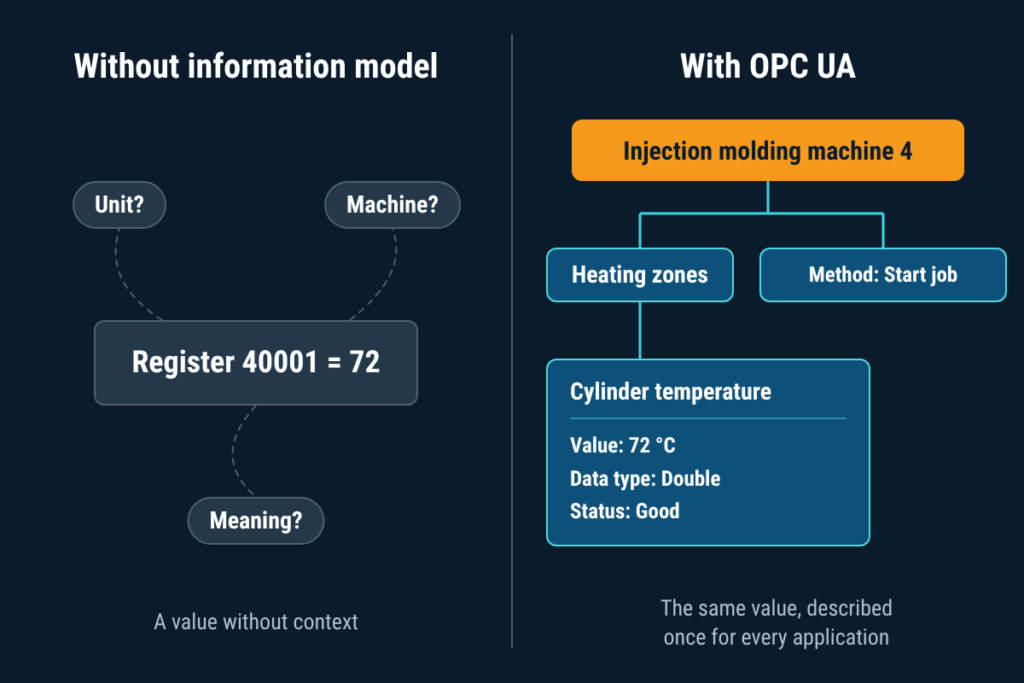
A controller that reports the value 72 in register 40001 tells an IT system very little. Is it a temperature, a pressure or a counter? In degrees Celsius or Fahrenheit? Which machine, which line, which plant? In many factories this knowledge sits in the heads of a few automation engineers or in spreadsheets that map addresses to meanings. Every new application has to rebuild that mapping, and every additional line repeats the effort.
The result is a factory that looks connected from the top floor while the data still does not flow. In the State of Manufacturing Report 2026, a survey of 511 manufacturing professionals in the United States from July 2026, 77% describe their operations as fully or mostly connected. Only 40% say they are connected across design, production, quality and business systems, and 67% do not have data from most of their systems integrated into a single view.
This gap becomes expensive as soon as a use case is meant to scale. Analytics, Industrial AI and energy management all need data that explains itself. OPC UA addresses the problem where it starts: at the machine, where the meaning of a value is still known and can be described once for every application that follows.
At the heart of every OPC UA server is its address space. It describes the machine as a network of nodes that are linked by references. Objects stand for physical or logical things, such as a machine, a spindle or a mold. Variables carry the current values, together with data type, engineering unit, timestamp and status. Methods let a client trigger functions on the machine, and types define reusable templates, so that every machine of the same kind is described the same way.
A client can browse this structure like a file system. For an injection molding machine it might find an object for the machine, below it an object for the heating zones and in there a variable for the cylinder temperature in degrees Celsius. The client does not need to know the register address, because the model tells it what the value is and where it belongs.
The services that work on this model are standardized. Clients read and write values, subscribe to changes so that the server sends new values only when they change, call methods, receive alarms and events and query historical data. On the wire, OPC UA mostly uses a compact binary protocol over TCP with the address scheme opc.tcp. HTTPS and WebSockets are defined as alternatives for environments that only allow web traffic.
The classic way to use OPC UA is client/server. The client opens a secure session with the server, browses the address space and sets up subscriptions. This pattern is well suited for engineering tools, SCADA systems and edge gateways that need a direct, bidirectional connection to a machine. Its limit lies in the number of connections, because every client opens its own session and every session costs resources on the server.
That matters most on the controller itself. Servers that are embedded in a PLC share CPU and memory with the control task and therefore expose only a limited number of nodes and monitored items. Our expert article on the node limit of the S7-1200 shows how this plays out in practice and how to read every tag anyway.
With Part 14 of the specification, OPC UA added a publish/subscribe model. A publisher sends its data sets without knowing who receives them, and any number of subscribers can listen. The specification defines transports over UDP for the field level as well as over MQTT and AMQP for brokers and the cloud. Messages can be encoded in a compact binary format or as JSON, which makes OPC UA semantics readable for IT systems that already work with MQTT.
OPC UA FX (Field eXchange) extends the standard to the field level. The OPC Foundation’s Field Level Communications initiative has published the first UAFX specifications, which cover controller-to-controller communication across vendors. Controller-to-device and device-to-device communication are announced as future extensions.
The core specification defines how an information model is built. Companion Specifications define what it contains for a specific type of machine. Industry associations and working groups agree on which objects, variables and methods, for example, a machine tool, a robot or a weighing system exposes. A client that knows the Companion Specification can work with every compliant machine without vendor-specific mapping.
According to the OPC Foundation, there are now more than 430 Companion Specifications. The online reference lists models for machine tools, robotics, PackML, plastics and rubber machinery, machine vision, pumps, weighing technology and many more. In April 2026 the OPC Foundation announced that it will convert all of them into formats for AI applications, such as retrieval-augmented generation and the Model Context Protocol. The same semantics that help an MES today are meant to help AI agents understand machines tomorrow.
In existing plants, the picture is more mixed. Many machines in operation implement no Companion Specification, an older version or no OPC UA at all. A data architecture therefore has to deal with both: standardized models where they exist and a consistent model of its own where they do not.
The classic automation pyramid stacks sensors and actuators, controllers, SCADA, MES and ERP in layers. Data travels from one level to the next, and each level talks to the one below through its own interfaces. OPC UA was designed to carry data from field devices up to enterprise systems, and in practice it is mainly used where controllers and machines hand their data to supervisory systems.
OPC UA makes these interfaces more uniform, yet the basic pattern of the pyramid stays the same. When the MES, the energy management system, the quality application and a data lake each open their own connection to every machine, the number of point-to-point links grows with every new system. This is the reason many manufacturers combine OPC UA at the source with a central data hub above it.
OPC UA is often compared with MQTT, Sparkplug B and Modbus. The four do different things and frequently appear in the same architecture. The table shows where each of them is strongest.
| OPC UA | MQTT | Sparkplug B | Modbus | |
|---|---|---|---|---|
| Origin | OPC Foundation, 2008, IEC 62541 | Open standard (OASIS, ISO) | Eclipse Foundation specification on top of MQTT, ISO/IEC 20237 | Modicon, 1979 |
| Communication | Client/server, PubSub as an extension | Publish/subscribe via a broker | Publish/subscribe via a broker with a defined topic structure | Request/response |
| Data model | Information model with types, units and relationships | None, the payload can be defined freely | Defined payload with metrics, data types and device states | Numbered registers and coils without meaning |
| Typical position | At the machine and the controller | From the edge to the plant, the enterprise and the cloud | Between edge nodes and SCADA or host applications | Field devices, meters, drives and older controllers |
| Security | Authentication, signing and encryption built in | TLS and authentication at the broker | Uses the security of MQTT | None in the classic protocol |
| Strength | Describing machine data with semantics | Distributing data to many systems | Interoperable MQTT payloads for industrial applications | Simple and very widespread |
In practice the protocols complement each other. Modbus and native controller protocols reach older equipment, OPC UA describes modern machines with semantics and MQTT distributes the results through an MQTT broker to every application that needs them. Sparkplug B adds shared rules for topics and payloads when many MQTT clients from different vendors have to understand each other. How MQTT itself works, including a comparison with HTTP, is explained on our MQTT page.
A Unified Namespace (UNS) is a central, event-driven data hub in which every system publishes its current state and every application finds the data it needs. In most implementations an MQTT broker forms its backbone, and the topic structure follows the ISA-95 hierarchy from enterprise and site to area, line and cell.
OPC UA plays a clear role in this picture. It is the preferred way to read modern machines, and its information model provides exactly the context that a UNS needs: names, units, data types and the position of each value in the machine. An edge layer reads the OPC UA server once, maps the nodes to the topic hierarchy and publishes the values together with their metadata. From there, any number of applications can subscribe without adding a single connection to the controller.
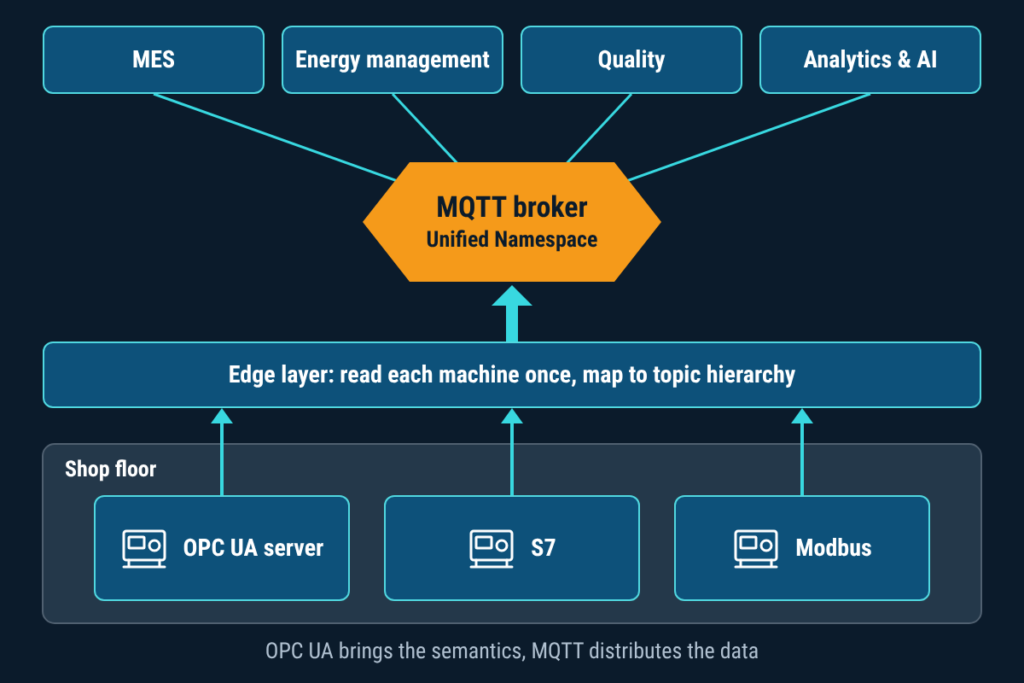
OPC UA PubSub over MQTT offers a standardized path for this mapping. In existing plants, the translation is usually done at the edge, because it also has to cover machines that speak only S7, Modbus or proprietary protocols.
On a single line almost any interface works, because the people who built it know what each value means. The value of OPC UA becomes visible when the same use case is rolled out to the next line, the next plant or the next machine generation. A model that describes the data once spares every later project from mapping it again. The broad support behind the standard adds to this: the OPC Foundation counts more than 1,010 member companies.
OPC UA is a strong standard, but brownfield factories rarely consist only of modern machines. These are the typical stumbling blocks and how to deal with them.
| Challenge | What happens | How to deal with it |
|---|---|---|
| Machines without OPC UA | Many controllers in operation speak only S7, Modbus or proprietary protocols. | Read them in their native protocol and describe the data in a common model at the edge. |
| Limited embedded servers | Servers inside a PLC expose only a limited number of nodes and monitored items. | Read several nodes per request, adjust sampling rates or switch to the native controller protocol. |
| Many client connections | Every consuming system opens its own session and adds load to the machine. | Read each machine once and distribute the data through a broker. |
| Inconsistent models | Without a Companion Specification, every vendor models its machines differently. | Map the data to a shared structure such as an ISA-95 based topic hierarchy. |
| Certificate management | Every client and server needs certificates that must be trusted, distributed and renewed. | Manage certificates and trust lists centrally and plan their renewal. |
| Security switched off | Security features are available but often not activated in delivered products. | Disable the security mode None in production and check every endpoint. |
Machine states, counters and cycle times are among the first values most manufacturers read via OPC UA. Because the server delivers them with clear names and data types, they can be fed into an OEE calculation without guessing what each register means.
An MES needs order data, quantities and quality values from the machines and sends recipes and job data back. OPC UA supports both directions with read, write and method calls. Companion Specifications such as the one for injection molding machines and MES define this exchange in a standardized way. More on this on our page about MES integration.
Energy data rarely comes from a single source. In a case study of a global tool manufacturer, energy data was collected across a heterogeneous fleet via OPC UA, S7, Heidenhain and Modbus TCP and made available in real time. The full case study is available as a PDF in the next section.
Vibration, temperature and current values from OPC UA servers form the input for predictive maintenance models. For traceability, the timestamps and status information of OPC UA make it possible to link process values to individual parts and batches.

The manufacturer, with 3,500 employees and eight production sites, connected 120 machines across a heterogeneous fleet via OPC UA, S7, Heidenhain and Modbus TCP. Energy data is now available to all stakeholders in real time, fewer cleaning cycles reduce machine downtime and efficiency rose by 9%. Download the full case study as a PDF.
You are currently viewing a placeholder content from HubSpot. To access the actual content, click the button below. Please note that doing so will share data with third-party providers.
More InformationSecurity is part of the OPC UA architecture. Applications identify each other with X.509 certificates, users log in with a user name and password, a certificate or a token and each connection runs in one of three security modes: None, Sign or SignAndEncrypt. Security policies such as Basic256Sha256 define the algorithms that are used.
Germany’s Federal Office for Information Security (BSI) examined the standard in depth. In its OPC UA Security Analysis (version 1.2, January 2022) it rates the security mechanisms of the specification as suitable for a high level of protection. At the same time, the analysis points out that many products do not activate these functions by default. The actual level of security therefore depends on configuration and implementation.
In his expert article on the S7-1200 OPC UA node limit, Dr. Diwaker Jha from Cybus shows how a dual-protocol strategy with OPC UA and native S7plus makes every tag of a controller visible without re-engineering.
Cybus Connectware works with OPC UA in both directions. As a client it reads OPC UA servers on machines and controllers, and as a server it makes data from other protocols available as OPC UA nodes. The values flow into a common data model and from there to every application that needs them.
All details on the OPC UA connector can be found on the page OPC UA in the Connectivity Portfolio.
trusted by







Open Platform Communications Unified Architecture. The term OPC goes back to the first specifications from the 1990s, which were based on Microsoft technology. Unified Architecture refers to the combination of all earlier OPC functions in one platform-independent framework.
OPC UA is more than a transport protocol. It is a framework that combines an information model, standardized services and several transport mappings. The binary protocol over TCP is the most common of these mappings.
OPC DA is part of OPC Classic, runs only on Windows and transports values with timestamp and quality. OPC UA is platform-independent, describes data in an information model and brings its own security mechanisms.
The default port for OPC UA over TCP is 4840. Servers can be configured to use other ports, and OPC UA over HTTPS or WebSockets usually runs on port 443.
The server provides the address space of a machine or system with its data and functions. The client connects to the server and reads, writes, subscribes to values or calls methods. Many systems act as both.
The two protocols complement each other. OPC UA describes data with semantics at the machine, MQTT distributes data efficiently to many applications. OPC UA PubSub can also use MQTT as its transport.
PubSub is the publish/subscribe extension defined in Part 14 of the specification. Publishers send data sets to a network or broker without a session per receiver, either over UDP or over MQTT and AMQP.
A Companion Specification is a standardized information model for a type of machine or an industry, for example machine tools, robots or injection molding machines. According to the OPC Foundation, more than 430 of them exist.
The specification provides authentication with certificates, signing and encryption. The BSI rates these mechanisms as suitable for a high level of protection. In practice, security depends on activating and configuring them correctly.
OPC UA is usually the source connection. Its information model supplies names, units and structure, which an edge layer maps into the topic hierarchy of the Unified Namespace and publishes via MQTT.
You need to load content from reCAPTCHA to submit the form. Please note that doing so will share data with third-party providers.
More InformationYou are currently viewing a placeholder content from Turnstile. To access the actual content, click the button below. Please note that doing so will share data with third-party providers.
More InformationYou are currently viewing a placeholder content from Facebook. To access the actual content, click the button below. Please note that doing so will share data with third-party providers.
More InformationYou are currently viewing a placeholder content from Hubspot Embedded Content. To access the actual content, click the button below. Please note that doing so will share data with third-party providers.
More InformationYou are currently viewing a placeholder content from HubSpot. To access the actual content, click the button below. Please note that doing so will share data with third-party providers.
More InformationYou are currently viewing a placeholder content from Hubspot Meetings. To access the actual content, click the button below. Please note that doing so will share data with third-party providers.
More InformationYou are currently viewing a placeholder content from Instagram. To access the actual content, click the button below. Please note that doing so will share data with third-party providers.
More InformationYou are currently viewing a placeholder content from reCAPTCHA. To access the actual content, click the button below. Please note that doing so will share data with third-party providers.
More InformationYou are currently viewing a placeholder content from X. To access the actual content, click the button below. Please note that doing so will share data with third-party providers.
More Information