In short: A Unified Namespace is a modern architecture for exchanging data in industry. Instead of connecting every machine, application or data source to each other individually, the Unified Namespace (UNS) relies on a central data layer as the single source of truth. All information comes together there in real time and is distributed from there.
Jump to: Architecture · Benefits · Challenges · UNS checklist · Examples · Implementation · FAQ
The term comes from the Industry 4.0 community and was popularized above all by IIoT consultant Walker Reynolds. Technically, a UNS is not a single product but an architectural principle. It is built on three components:
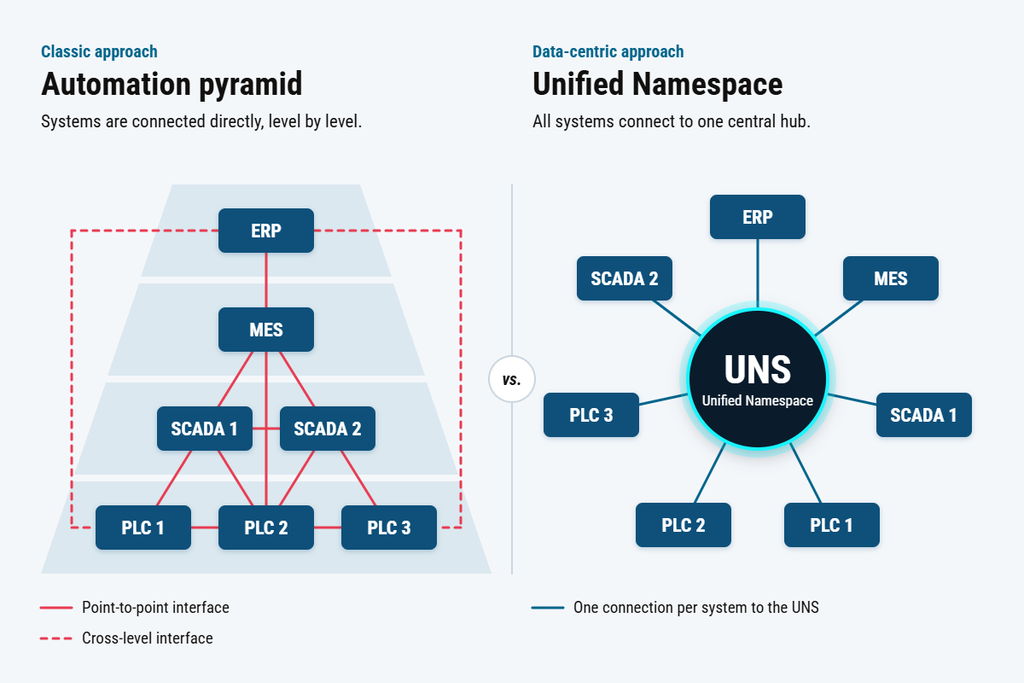
In most factories, every system is connected directly to the others. The MES pulls data from the controller, the ERP from the MES, and energy monitoring has its own connections. With every new application, the number of connections grows, in the worst case to n × (n−1) / 2 for n systems. With 10 systems that means up to 45 individual connections, with 20 systems already 190, all of which have to be built and maintained.
The classic ISA-95 automation pyramid makes the problem worse. Data moves up layer by layer and loses timeliness and context along the way. Typical consequences:
What this “data jungle” looks like in practice is described in our article No Unified Namespace. No Smart Factory.
The UNS replaces the vertical pyramid with a horizontal data hub. All systems connect to one central point instead of talking to each other directly.
Data sources (publishers) send new values to the UNS as soon as they change. Applications (subscribers) subscribe to exactly the data they need. Publishers and subscribers do not know each other. A new application therefore does not need a new interface to the machine, just a subscription.
Most UNS implementations rely on MQTT: lightweight, asynchronous, low latency and widely supported in both OT and IT. OPC UA remains important, especially for connectivity and modeling at machine level. In practice, the two complement each other: OPC UA at the machine, MQTT in the UNS. For consistent payloads and state messages, many projects also use the MQTT specification Sparkplug B.
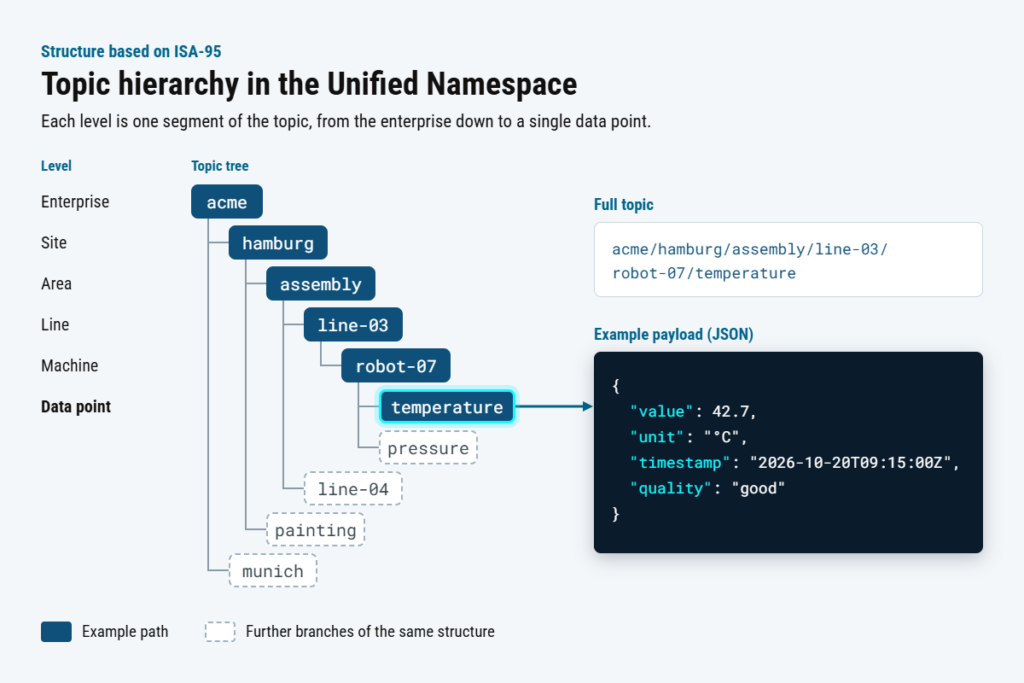
A consistent topic structure is a prerequisite for a UNS. Many projects base it on the ISA-95 hierarchy:
| Level | Example topic |
|---|---|
| Enterprise | acme |
| Plant | acme/hamburg |
| Area | acme/hamburg/assembly |
| Line | acme/hamburg/assembly/line-03 |
| Machine | acme/hamburg/assembly/line-03/robot-07 |
| Data point | acme/hamburg/assembly/line-03/robot-07/temperature |
This way, every application finds data using the same logic, no matter which plant it is in. The graphic shows how the topic tree branches out and what a typical payload looks like: JSON with value, unit, timestamp and quality.
Only contextualized data creates value. A data model defines naming conventions, units and metadata before the data is published. This turns a raw signal into information that MES, analytics and AI can understand directly.
Large companies rarely run a single central broker. A distributed architecture is common: local UNS instances per plant for autonomy and low latency, connected to an enterprise level for cross-site analytics. If the connection fails, the plant keeps producing.
A UNS does not run itself. If you know the typical pitfalls, you can plan for them from the start.
| Challenge | Solution |
|---|---|
| The central broker becomes a single point of failure | Run the broker as a high-availability cluster, with local UNS instances per plant so production continues if the connection is lost |
| Heterogeneous brownfield equipment with many protocols | A connectivity layer with ready-made protocol adapters (OPC UA, S7, Modbus and others) that normalizes data before publishing |
| Uncontrolled growth of topics and data models | Define binding naming conventions and a data model before the first machine is connected |
| Operating effort across many sites | Version configuration as code, roll it out via templates and monitor it centrally |
| Unclear responsibilities between OT and IT | A joint UNS team with clear data owners per area and plant |
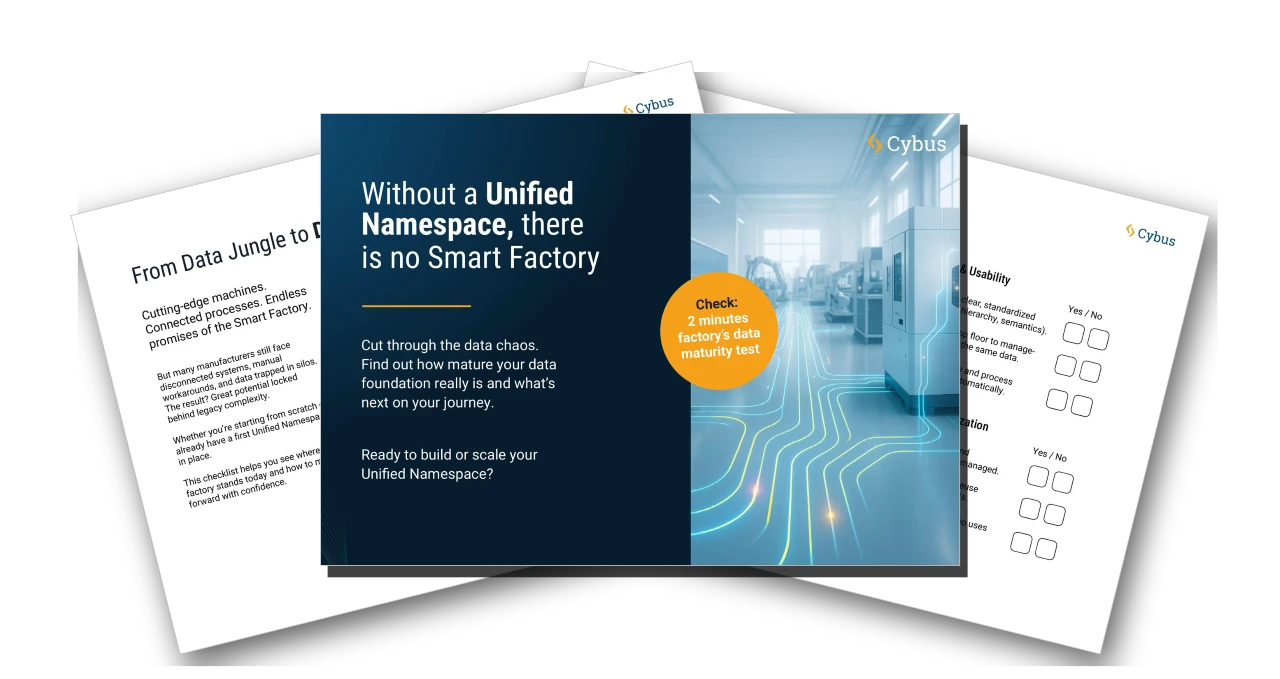
Twelve questions across four areas show you where your factory stands on the path to a Unified Namespace and what needs to be clarified before you start.
You are currently viewing a placeholder content from HubSpot. To access the actual content, click the button below. Please note that doing so will share data with third-party providers.
More InformationPLC, sensor and energy data come together in a structured way in the UNS. This results in consistent KPIs such as OEE across all lines, without separate integrations per line.
Production data is provided once in the UNS. MES and ERP subscribe only to the information they need, such as order status, quantities or scrap. Custom interfaces are no longer necessary. Learn more about MES integration and OT and IT integration.
Machine and sensor data with context enable anomaly detection and maintenance forecasts. Unplanned downtime can be detected earlier. See Predictive Maintenance.
Multiple plants use the same data model. Local UNS instances connect via a central governance layer. Blum, for example, chose Cybus Connectware as its global standard for its industrial data infrastructure.
In automotive manufacturing, data from hundreds of robots, controllers and test benches in the body shop, paint shop and final assembly comes together. A UNS with a consistent topic structure per plant and line makes cycle times, quality data and downtime comparable across plants. A worked example from an automotive plant can be found in the deep dive on scaling.
You can find more scenarios in our use cases.
A UNS connects existing systems instead of replacing them. The key differences:
| Unified Namespace | Data Lake | MES | |
|---|---|---|---|
| Purpose | Distribute the current state in real time | Store and analyze raw data over the long term | Control and document production |
| Time reference | Now (event-driven) | Past (history) | Order and shift |
| Data form | Structured and contextualized | Raw, structured and unstructured | Application-specific |
| Role in the overall system | Supplies data to the data lake and MES | Consumes data from the UNS | Consumes and publishes data in the UNS |
The Unified Namespace is the nervous system, the data lake is the long-term memory. How the UNS relates to the concept of a central data hub is explained in the glossary entry Factory Data Hub.
When all data sits in one place, it must be clearly defined who may read and write what. A production-ready UNS needs:
What works in real projects and why UNS implementations fail is discussed by experts from Cybus and MaibornWolff in the expert panel Define Your Unified Namespace.
Cybus Connectware is the Industrial DataOps platform for building your UNS locally, across sites or globally.
You can find all features, references and how to get started on the product page.
trusted by









A central place where all machines and systems in a factory store their current data in a consistent structure. Every application takes what it needs from there.
UNS is the abbreviation for Unified Namespace. In manufacturing, the term refers to a central data layer in which machines, lines and IT systems share their current state in a consistent structure.
A robot on line 3 of the Hamburg plant publishes its temperature under acme/hamburg/assembly/line-03/robot-07/temperature. Dashboard, MES and maintenance software subscribe to this value without a direct connection to the robot.
Not necessarily, but MQTT is the most widely used standard because it is lightweight and natively supports publish/subscribe.
A UNS broker is the central component that distributes all data in a Unified Namespace using the publish/subscribe principle. In practice, this is almost always an MQTT broker: data sources publish their values to it, and applications subscribe to the topics they need. For production use, the broker should run as a high-availability cluster so it does not become a single point of failure.
OPC UA is a communication protocol with an information model, mostly used at machine level. The UNS is an architectural principle for the entire enterprise. OPC UA data is often fed into the UNS.
A Factory Data Hub is the software platform that collects, processes and distributes data from machines and IT systems. The UNS is the architectural principle according to which this data is structured and provided. In practice, a UNS is often built on a Factory Data Hub.
ISA-95 provides the proven hierarchy (enterprise, plant, area, line, machine) that is used to structure the topics in the UNS.
Yes. Even older controllers and machines in brownfield environments are connected via a connectivity layer with protocol adapters such as S7, Modbus or OPC UA. There, the data is normalized and enriched with context before it is published to the UNS. Replacing the equipment is not necessary.
A first use case on one line can be implemented in a few weeks. Rolling out to further plants is much faster than the initial setup thanks to templates and Infrastructure as Code.
You need to load content from reCAPTCHA to submit the form. Please note that doing so will share data with third-party providers.
More InformationYou are currently viewing a placeholder content from Turnstile. To access the actual content, click the button below. Please note that doing so will share data with third-party providers.
More InformationYou are currently viewing a placeholder content from Facebook. To access the actual content, click the button below. Please note that doing so will share data with third-party providers.
More InformationYou are currently viewing a placeholder content from Hubspot Embedded Content. To access the actual content, click the button below. Please note that doing so will share data with third-party providers.
More InformationYou are currently viewing a placeholder content from HubSpot. To access the actual content, click the button below. Please note that doing so will share data with third-party providers.
More InformationYou are currently viewing a placeholder content from Hubspot Meetings. To access the actual content, click the button below. Please note that doing so will share data with third-party providers.
More InformationYou are currently viewing a placeholder content from Instagram. To access the actual content, click the button below. Please note that doing so will share data with third-party providers.
More InformationYou are currently viewing a placeholder content from reCAPTCHA. To access the actual content, click the button below. Please note that doing so will share data with third-party providers.
More InformationYou are currently viewing a placeholder content from X. To access the actual content, click the button below. Please note that doing so will share data with third-party providers.
More Information