In short: A dark factory is a production facility in which machines, robots and software carry out manufacturing largely without people on site, so that it could in principle run with the lights off. The term is often used as a synonym for lights-out manufacturing or a lights-out factory. In practice, very few plants run completely dark around the clock. Most manufacturers run individual cells, lines or night shifts unattended while people monitor operations remotely, maintain the equipment and handle exceptions. Every dark factory depends on a continuous flow of reliable real-time data from all machines, because sensors and software have to take over the decisions that people on the shop floor used to make.
Jump to: Terms · The problem · Architecture · Maturity levels · Benefits · Challenges · Checklist · Examples · Governance · Implementation · FAQ
The terms around automated production overlap, and they are often used interchangeably. The difference lies mainly in how much of the plant runs without people and for how long. A dark factory describes the end state, lights-out manufacturing the practice of running production unattended and a smart factory the connected plant that both build on.
| Term | What it means | Typical scope |
|---|---|---|
| Dark factory | A plant in which production runs without people on site for long periods. People plan, monitor remotely and handle exceptions. | Entire plant or building, still rare in practice |
| Lights-out manufacturing | Unattended production, widely used as a synonym for dark factory. Also called lights-out production. | Cells, lines or shifts |
| Lights-sparse factory | A plant in which only selected areas or production phases run unattended, while other areas remain staffed. | Single cells, night or weekend shifts |
| Smart factory | A connected plant in which machines, systems and people exchange data continuously. People remain on the shop floor. | Entire plant |
| Autonomous manufacturing | Production that plans, controls and corrects itself to a large extent, increasingly with AI agents. | Planning, control and quality processes |
On this page, dark factory refers to the goal of unattended production and lights-out manufacturing to the practical steps toward it, from the first unattended cell to an entire plant.
For decades, automation meant making individual machines faster and more precise. The pressure that drives manufacturers toward unattended production today comes from somewhere else: demographics. In a study published in April 2026, Roland Berger expects Europe’s working-age population to shrink by 18 percent by 2050 and describes labor scarcity as a structural problem for manufacturing. Production leaders already feel it on night and weekend shifts, which are getting harder to staff every year.
Competitive pressure is rising at the same time. According to the International Federation of Robotics (IFR), factories worldwide installed more than 600,000 industrial robots in 2025, and 354,000 of them, or 59 percent, went to China. Germany installed fewer than 25,000 units, eight percent fewer than the year before. With 469 robots per 10,000 manufacturing employees, it still ranks third worldwide in robot density, well above the global average of 152.
What holds most plants back is the coordination around the machines. Roland Berger names fragmented IT systems with poorly integrated ERP, PLM and MES, inconsistent data quality and unplanned disruptions as the reasons why many functions still require constant manual intervention. Assembly remains a bottleneck too, because product variance and flexible parts such as cables and tubes are hard to handle automatically. In a conventional plant, people bridge these gaps on every shift: they walk to the machine, read a display, call a colleague or adjust a parameter. Once nobody is on site, each of these interventions needs a data point and a system that can act on it.
Robots, CNC machines and automated transport systems are the visible part of a dark factory. Below them sits a less visible infrastructure that decides whether unattended operation lasts for one hour or for a whole weekend. It typically consists of six layers:
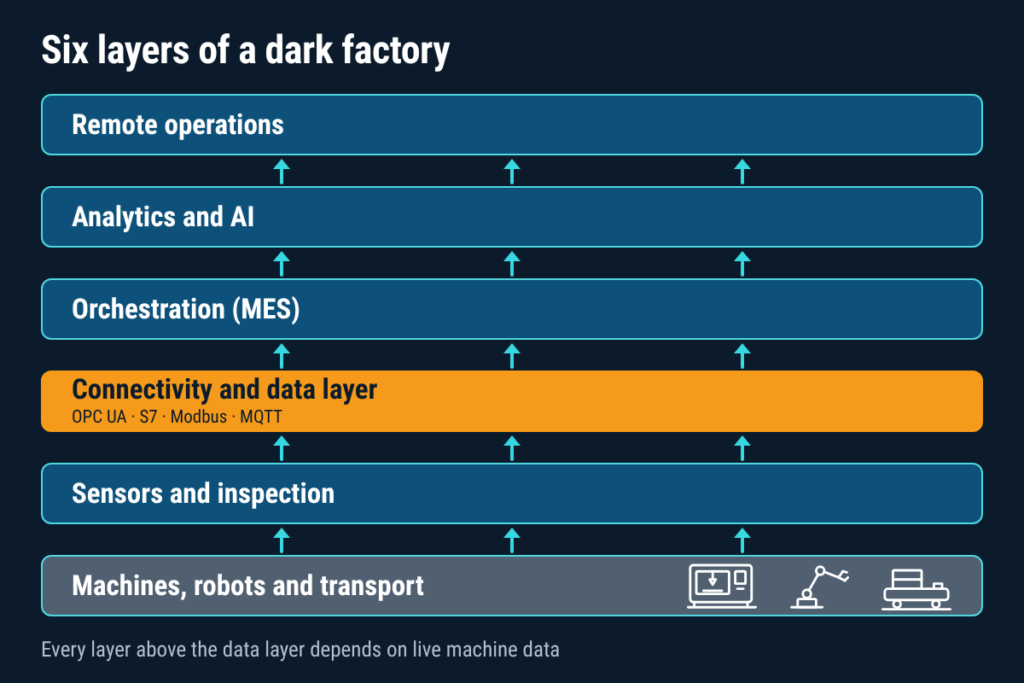
The data layer works like the nervous system of the plant. Every alert in the control room, every AI model and every automatic restart depends on it. When machine data arrives late, incomplete or without context, the control room loses sight of the line and AI models work with guesses. A digital twin can help to test changes virtually before they reach the line, and it needs the same live data from the shop floor. More on how machines are connected in practice is explained in the article on shop floor connectivity.
Few manufacturers build a dark factory from scratch. Roland Berger sees full lights-out operation as a long-term goal and step-by-step autonomy as the realistic path. The five maturity levels below help to locate a plant on that path and to see what each next step requires. This classification is a simplified model by Cybus, based on the studies by Roland Berger and EY.
| Level | What it looks like | What it requires |
|---|---|---|
| 1. Manual and attended | People operate and monitor machines on every shift. | Basic machine data, often recorded by hand |
| 2. Attended automation | Machines and robots run automatically, while operators stay at the line to load, check and restart. | Machine connectivity and live dashboards |
| 3. Unattended cells | Single cells, often in machining or molding, keep running through breaks and night shifts. | Automated loading, condition monitoring and alerts to an on-call team |
| 4. Lights-out lines and shifts | Entire lines or night and weekend shifts run without people on site. | Real-time data flow between machines, MES and quality systems, remote monitoring and predictive maintenance |
| 5. Dark factory | Production runs unattended for long periods. People plan, monitor and handle exceptions. | Closed-loop control, AI on real-time data, redundancy and governance with kill switches and audit trails |
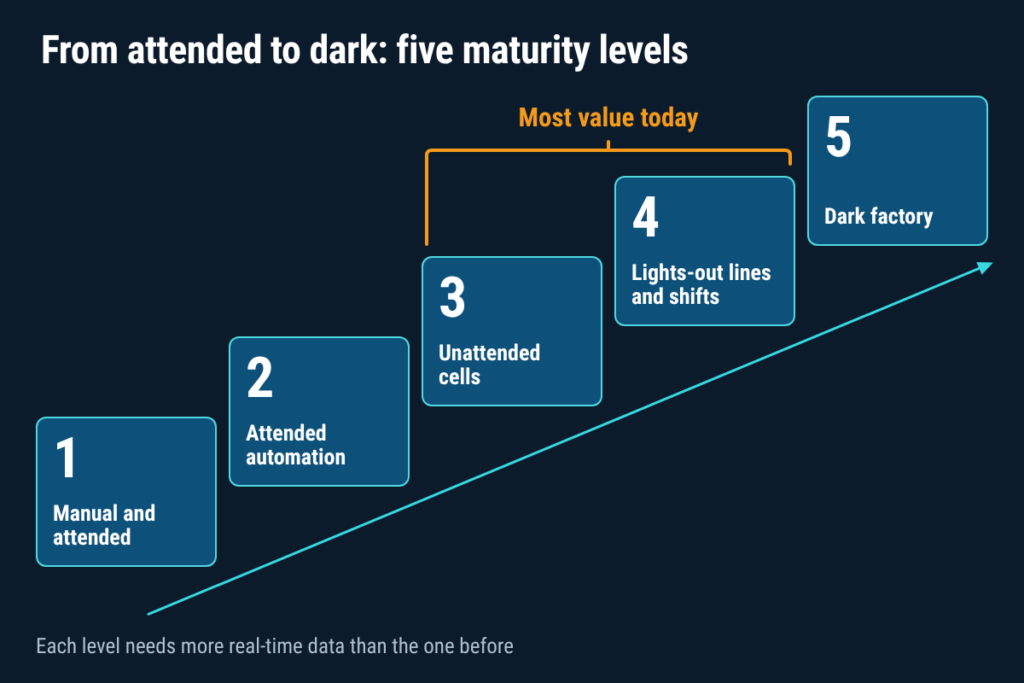
Levels 3 and 4 hold most of the value today, and they are within reach for brownfield plants with an existing installed base. Each level needs more data than the one before, which is why the data foundation should be built so that it carries from the first cell to the entire plant.
The most direct benefit is more productive hours from the same machines. Roland Berger cites MTU, which commissioned a fully automated airfoil production process that can run autonomously for up to 66 hours. In the process industry, Unilever reports that automating routine work nearly doubled labor productivity at its plant in Tianjin, China. Beyond capacity, unattended production brings further advantages:
In an attended plant, an operator clears a jammed part within a minute. In a dark factory, the same jam can stop the line until the morning shift arrives. Unattended production therefore raises the bar for reliability, data and organization. The table shows the most common challenges and how manufacturers address them.
| Challenge | Why it matters | How manufacturers address it |
|---|---|---|
| Product variance and flexible parts | Many variants and parts such as cables and hoses are hard to handle automatically. | Design for automation, platform strategies and a start with high-volume, low-variance processes |
| Unplanned downtime | Without people on site, faults go unnoticed for longer and stoppages last longer. | Condition monitoring, predictive maintenance, redundancy and clear escalation paths |
| Fragmented systems | ERP, MES, quality systems and machines rarely share data in real time. | A shared data layer that connects the existing systems and leaves them in place |
| Mixed installed base | Machines from different decades speak different protocols. | Connectivity that reads each controller in its native protocol, with no changes to PLC programs |
| Cybersecurity | More connectivity and remote access enlarge the attack surface. | Network segmentation, encrypted connections and role-based permissions from day one |
| Workforce and skills | Roles shift from operating machines to monitoring, maintenance and data. | Early involvement of the workforce, training and clearly defined human roles |
| Investment | Full automation is expensive and pays off mainly at high volumes over long periods. | A step-by-step rollout that starts where unattended hours create the most capacity |

A dark factory runs on AI that works with live data from every machine. Twelve questions across four areas show you where your factory stands on the path to Industrial AI and what your next step should be, whether you are just getting started or planning to scale.
You are currently viewing a placeholder content from HubSpot. To access the actual content, click the button below. Please note that doing so will share data with third-party providers.
More InformationDark factory principles are furthest along where high volumes, repeatable processes and tight tolerances come together. Fully dark plants remain the exception, while unattended cells, lines and shifts are spreading across many industries.
Electronics manufacturing combines very high volumes with small, precise components that are well suited to robots. According to Roland Berger, Xiaomi operates a nearly fully automated production plant in Beijing with an estimated annual output of ten million smartphones. The plant is often cited as the prime example of a dark factory.
China is pushing automation faster than any other country. In 2025, 59 percent of all new industrial robots worldwide were installed there. According to the IFR, the 15th Five-Year Plan for 2026 to 2030 steers China’s robotics strategy toward technological self-reliance. Unattended production also reaches beyond electronics: Unilever runs its plant in Tianjin with what it calls lights-out production, around the clock and with minimal operator intervention.
High-volume, low-mix machining and molding are among the processes that can already run lights-out shifts today, thanks to automated setup and changeover. The MTU example with up to 66 hours of autonomous airfoil production comes from this area. Machining cells that run through the night are often the first step toward unattended production in brownfield plants.
In chemicals, pharmaceuticals and food, completely dark plants are still rare. The trade publication of POWTECH TECHNOPHARM describes how the building blocks are already in use: advanced process control, soft sensors, digital twins, AI-based anomaly detection and robotic inspection create autonomous islands within the process, from dosing and mixing to filling and palletizing.
Material flow is often the area where unattended operation starts. Autonomous mobile robots take over transports between stations, and automated warehouses run without people in the storage area. EY counts autonomous warehousing as one of three domains of lights-out operations, next to autonomous planning and dark factory manufacturing.
Unattended production shifts responsibility from the operator at the machine to rules, systems and a small team in the control room. EY describes dark factory operations as production lines that run unattended for a defined time and rely on certified safety, inline quality data and closed-loop control, while people keep kill switches, escalation paths and audit trails. In practice, governance for a dark factory covers six areas:
Step five is where many projects stall. The first unattended cell often runs on a custom integration, and the second line needs the same work all over again. A shared data foundation lets each new cell build on the previous one. In his article on Software-Defined Manufacturing, Peter Sorowka, CEO of Cybus, explains why factories need an architecture that keeps change cheap.
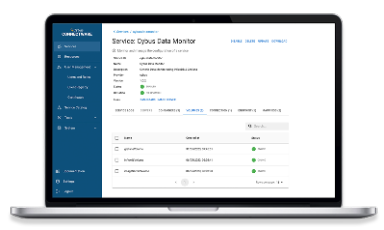
Cybus Connectware is the data foundation that connects the shop floor of manufacturing companies with their IT. It reads machines and systems in their native protocols, structures the data and distributes it to any application, on premises, at the edge or in the cloud. Existing machines and PLC programs stay untouched. This makes it the base layer on which control rooms, MES, predictive maintenance and AI agents work with the same live data, from the first unattended cell to every plant.
The agricultural machinery manufacturer CLAAS chose Cybus Connectware after more than 80 technical validations in a proof of concept. The framework agreement covers up to eight plants and around 1,000 assets, all managed from one central instance. Read the CLAAS story. The KRONE Group built its greenfield smart factory in Ibbenbüren from the ground up within twelve months, on an event-driven architecture with Cybus Connectware at its core. Read the KRONE story.
The built-in broker is called CybusMQ and comes as part of Cybus Connectware.
trusted by










A dark factory is a production facility in which machines, robots and software carry out manufacturing largely without people on site. People plan production, monitor it remotely and step in for maintenance and exceptions. In practice, most companies run individual cells, lines or shifts unattended and expand from there.
The two terms are usually used as synonyms. Where a distinction is made, dark factory describes an entire plant that runs unattended, and lights-out manufacturing describes unattended production in general, which can also apply to a single cell or a night shift.
Without people on site, a plant needs no lighting for workers, so it could in principle run in the dark. The name is largely a metaphor, because cameras and optical sensors often still need light. What matters is that production keeps running without people at the machines.
Yes, in specific areas. Examples include highly automated electronics plants such as the Xiaomi smartphone factory in Beijing, machining cells that run through the night and automated warehouses. Plants that run completely dark around the clock across all processes remain rare.
The best-known example is the Xiaomi smartphone plant in Beijing with an estimated annual output of ten million devices. Unilever runs its plant in Tianjin with lights-out production around the clock. China installed 59 percent of all new industrial robots worldwide in 2025, according to the IFR.
Yes. People plan production, monitor it from a control room, carry out maintenance, handle exceptions and improve processes. Their role shifts from operating machines to overseeing systems, which requires new skills and clear rules for when a person has to decide.
Industrial robots, automated machines and autonomous mobile robots carry out the physical work. Sensors, machine vision and condition monitoring capture the state of the plant. A data layer connects all machines in real time, an MES orchestrates production and AI detects anomalies and optimizes processes. A remote control room ties everything together.
Maintenance relies on condition monitoring and predictive maintenance. Sensors report the state of machines continuously, software detects deviations early and technicians are sent only when the data shows that a physical intervention is needed. Planned maintenance windows replace unplanned stops during unattended shifts.
Yes, step by step. Brownfield plants usually start with a single cell or a night shift, connect the existing machines without changing them and remove the reasons for manual intervention one by one. A shared data foundation makes it possible to transfer what works to further lines and plants.
The term is also used for AI-driven pipelines in which agents write, test and deploy code with little human involvement. This page covers the original meaning from manufacturing: production plants that run largely without people on site.
You need to load content from reCAPTCHA to submit the form. Please note that doing so will share data with third-party providers.
More InformationYou are currently viewing a placeholder content from Turnstile. To access the actual content, click the button below. Please note that doing so will share data with third-party providers.
More InformationYou are currently viewing a placeholder content from Facebook. To access the actual content, click the button below. Please note that doing so will share data with third-party providers.
More InformationYou are currently viewing a placeholder content from Hubspot Embedded Content. To access the actual content, click the button below. Please note that doing so will share data with third-party providers.
More InformationYou are currently viewing a placeholder content from HubSpot. To access the actual content, click the button below. Please note that doing so will share data with third-party providers.
More InformationYou are currently viewing a placeholder content from Hubspot Meetings. To access the actual content, click the button below. Please note that doing so will share data with third-party providers.
More InformationYou are currently viewing a placeholder content from Instagram. To access the actual content, click the button below. Please note that doing so will share data with third-party providers.
More InformationYou are currently viewing a placeholder content from reCAPTCHA. To access the actual content, click the button below. Please note that doing so will share data with third-party providers.
More InformationYou are currently viewing a placeholder content from X. To access the actual content, click the button below. Please note that doing so will share data with third-party providers.
More Information