In short: Industrial AI is the use of artificial intelligence in production and industrial operations. Machine learning, computer vision, language models and AI agents work with live data from machines, controllers and production systems to predict failures, detect quality issues, optimize processes or support operators. Unlike AI in office software, its results directly affect output, quality, uptime and safety. That is why the success of Industrial AI depends less on the model and more on whether the factory can deliver clean, contextualized data in real time.
Jump to: Architecture · Maturity levels · Benefits · Challenges · Industrial AI checklist · Examples · Implementation · FAQ
Most people think of generative AI when they hear the word AI: assistants that write text, summarize documents or answer questions. Industrial AI works in a different environment. It processes signals from PLCs, sensors, robots and MES, and its decisions end up on a production line. A wrong answer in an office tool costs a few minutes, while a wrong decision in production can cost scrap, downtime or a safety incident.
| Enterprise AI | Industrial AI | |
|---|---|---|
| Typical data | Documents, emails, CRM and ERP records | Machine signals, sensor values, PLC tags, MES events |
| Data quality at the source | Mostly structured and stored centrally | High-frequency, vendor-specific, often without context |
| Time requirements | Seconds to hours | Often milliseconds to seconds |
| Consequence of errors | A wrong text or a poor recommendation | Scrap, downtime or safety risks |
| Where it runs | Mostly in the cloud | At the edge in the plant and in the cloud |
The pattern is familiar in many factories. A data science team builds a promising model on one machine, using data that was exported and cleaned by hand. The pilot works. Then it is supposed to run on the next line and in the next plant, where the controllers come from a different vendor, the tags have different names and nobody knows exactly what a value means. The integration starts over from scratch, and the business case erodes with every site.
The reason is rarely the algorithm. Industrial data is spread across dozens of systems such as ERP, MES, SCADA, energy management and quality systems, and each of them stores it in its own format. Standard AI solutions cover generic tasks such as detecting whether a machine is running. Real value comes from models that know your machines, your processes and your supply chain, and they need your data, reliably and in real time. Typical consequences when that foundation is missing:
At the same time, the pressure is growing. IoT Analytics puts the Industrial AI market at USD 43.6 billion in 2024 and expects it to reach around USD 154 billion by 2030. Manufacturers that only scale pilots one by one will struggle to keep up. A 2026 study by the Manufacturers Alliance Foundation and Roland Berger confirms where the bottleneck lies: nearly two thirds of the surveyed manufacturers needed significant data clean-up and preparation before they could launch AI initiatives.
An Industrial AI application consists of far more than the model itself. Before an algorithm can deliver a reliable result, data has to pass through several layers:
In many factories, each of these layers is solved by a different tool, which means many interfaces and many places where data can be lost or misinterpreted. A central data layer combines unification and context in one place and provides all applications with the same data model. In practice, this layer is often built as a Unified Namespace: a consistent, event-driven representation of all machines, lines and processes that every AI application can subscribe to.
Industrial AI runs in two places. In the plant, models make fast decisions close to the machine, for example for anomaly detection, and keep working even if the connection to the cloud is interrupted. In the cloud, models are trained and data from several sites is compared. This only works if both places use the same data model. Otherwise every model has to be adapted to every plant.
For a person on the line, “73.4” is obviously the spindle temperature of a specific machine in degrees Celsius. A model or AI agent does not know that. It needs the context explicitly: what asset, what unit, what time, what quality, what order. This is especially true for language models and agents, which reason about data and can only act correctly if names and relationships are clear.
Industrial AI is not a single technology but a spectrum. All levels consume the same foundational data. The difference lies in the logic that runs on top of it. Investing once in connectivity, context and governance therefore pays off at every level.
| Maturity level | Typical application | Data requirements |
|---|---|---|
| Descriptive | OEE dashboards, anomaly alerts | High-volume time series, medium latency |
| Predictive | Predictive maintenance, energy forecasting | Long historical time windows, labeled events |
| Prescriptive | Dynamic scheduling, closed-loop process control | Real-time feedback, optimization targets |
| AI assistants and agents | Guidance for operators, autonomous material flow | Semantic context, clear permissions, traceable actions |
A solid data foundation pays off before any specific AI model is in place. Once machine data is connected and contextualized, classic production KPIs such as OEE, downtime, scrap or energy consumption can be measured and compared consistently across lines and plants, and that is the starting point for every improvement.
Manufacturers that have invested in connected, data-driven production already see the effect. In Deloitte’s 2025 Smart Manufacturing Survey of 600 executives, respondents reported up to 20% higher production output, up to 20% higher employee productivity and up to 15% of unlocked capacity from their smart manufacturing initiatives. At the same time, only 29% use AI or machine learning at facility or network level, so most of the potential is still ahead.
Industrial AI fails less often because of the technology than because of the conditions in the factory. If you know the typical hurdles, you can address them from the start.
| Challenge | Solution |
|---|---|
| Heterogeneous brownfield equipment with many protocols and vendors | A connectivity layer with ready-made protocol adapters that normalizes data before it reaches any AI application |
| Every site names and structures data differently | A shared data model and naming conventions, defined before the first use case |
| Pilots cannot be transferred to other plants | Versioned configuration as code and templates that can be rolled out to further lines and sites |
| Concerns about IT and OT security | Role-based access down to individual data points, encrypted communication and a complete audit trail |
| Lack of trust in AI decisions | Human-in-the-loop: AI recommends, people approve actions that affect production |
| Unclear responsibilities between OT, IT and data science | A joint team with clear data owners per area and plant |

Twelve questions across four areas show you where your factory stands on the path to Industrial AI and what your next step should be, whether you are just getting started or planning to scale.
You are currently viewing a placeholder content from HubSpot. To access the actual content, click the button below. Please note that doing so will share data with third-party providers.
More InformationModels detect patterns in vibration, temperature or power consumption that precede a failure. Maintenance can then be scheduled before the machine stops. See Predictive Maintenance.
Cameras on the line check parts automatically for defects. The model becomes much more useful when the image is linked to process data such as order, machine parameters and material batch, because the cause of a defect can then be traced back.
AI forecasts energy demand, detects consumption peaks and suggests better operating points. The prerequisite is energy data that is linked to machine states and production orders. Learn more about energy management and OEE.
A copilot answers questions such as “Why did line 3 stop last night?” by combining live machine data, alarm history and documentation. This only works if the assistant can access current, contextualized data with the right permissions.
Agents go one step further: they detect a deviation, create a maintenance order, check spare parts or adjust a schedule. In production, these actions need clear rules about what an agent may read and change, and a person who approves critical steps.
The real value of Industrial AI comes when a use case runs in every plant, not just in one. That requires the same data model everywhere. Blum, for example, chose Cybus Connectware as its global standard for its industrial data infrastructure.
You can find more scenarios in our use cases.
As soon as AI applications and agents access production data, the question is no longer just whether data is available, but who is allowed to do what with it. A production-ready setup for Industrial AI needs:
How to structure the data foundation for AI in detail is described by our CTO Jasmin Skenderi in the expert article The Foundation of AI in Manufacturing: Getting Your Data Right.
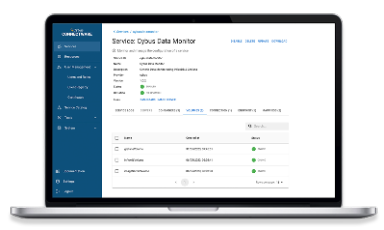
Cybus Connectware is not an AI application. It is the governed data foundation that AI applications, assistants and agents run on. It connects machines and IT systems across all sites, controls who may access which data and delivers clean, contextualized data in real time.
You can find all features and how to get started on the product page.
trusted by










Industrial AI is artificial intelligence that works with data from machines and production systems. It helps factories predict failures, detect quality issues, save energy or support operators in their work.
General-purpose and enterprise AI mostly works with text, documents and business data. Industrial AI processes high-frequency machine data, often has to react in milliseconds and directly affects output, quality and safety. That is why it places much higher demands on data quality, context and governance.
Typical examples are predictive maintenance, quality inspection with computer vision, energy optimization, AI assistants for maintenance teams and AI agents that create maintenance orders or adjust schedules.
Physical AI refers to AI that acts directly in the physical world, for example in robots or autonomous vehicles. It is part of Industrial AI, which also includes analytical applications such as forecasts, quality analysis or assistants.
Agentic AI describes AI agents that not only analyze data but independently trigger actions, such as a maintenance order or a schedule change. In production, agents need clear permissions, traceable actions and human approval for critical steps.
Rarely because of the model. The most common causes are data silos, missing context, integrations built for a single machine and unclear responsibilities. As a result, pilots work in one place but cannot be scaled to other lines and plants.
Industrial AI needs real-time and historical data from machines, sensors and systems such as MES and ERP. This data must be enriched with context, such as unit, asset, timestamp and order, and follow a consistent data model.
Not necessarily, but it helps a lot. A Unified Namespace provides all AI applications with the same structured, real-time data, so a new use case does not need a new integration.
Yes. Many models run at the edge directly in the plant, for example when latency matters or data must not leave the site. Training and cross-site analysis often take place in the cloud. It is important that both use the same data model.
With an existing data foundation, a first use case can be piloted in a few weeks. A typical pilot including connectivity and data model takes four to eight weeks. Rolling out to further plants is much faster thanks to templates.
You need to load content from reCAPTCHA to submit the form. Please note that doing so will share data with third-party providers.
More InformationYou are currently viewing a placeholder content from Turnstile. To access the actual content, click the button below. Please note that doing so will share data with third-party providers.
More InformationYou are currently viewing a placeholder content from Facebook. To access the actual content, click the button below. Please note that doing so will share data with third-party providers.
More InformationYou are currently viewing a placeholder content from Hubspot Embedded Content. To access the actual content, click the button below. Please note that doing so will share data with third-party providers.
More InformationYou are currently viewing a placeholder content from HubSpot. To access the actual content, click the button below. Please note that doing so will share data with third-party providers.
More InformationYou are currently viewing a placeholder content from Hubspot Meetings. To access the actual content, click the button below. Please note that doing so will share data with third-party providers.
More InformationYou are currently viewing a placeholder content from Instagram. To access the actual content, click the button below. Please note that doing so will share data with third-party providers.
More InformationYou are currently viewing a placeholder content from reCAPTCHA. To access the actual content, click the button below. Please note that doing so will share data with third-party providers.
More InformationYou are currently viewing a placeholder content from X. To access the actual content, click the button below. Please note that doing so will share data with third-party providers.
More Information