In short: AIoT stands for Artificial Intelligence of Things and describes the combination of artificial intelligence with the Internet of Things (IoT). Connected sensors, machines and devices collect data, and AI models analyze it, detect patterns and trigger decisions or actions, either directly on the device, at the edge in the plant or in the cloud. In manufacturing, the meaning of AIoT is very practical: machines that report their condition, predict failures and help adjust processes on their own. Whether this works beyond a single line depends less on the model than on whether the data from all devices arrives reliably, in a consistent format and with context.
Jump to: Terms · The problem · Architecture · How it works · Benefits · Challenges · Checklist · Examples · Governance · Implementation · FAQ
The terms overlap and are often used as synonyms. The clearest way to separate them is to ask what each one focuses on: the connection of devices, the place where AI runs or the use of AI in production as a whole. AIoT sits where these meet. It describes connected things whose data is evaluated by AI and turned into decisions.
| Term | What it describes | Focus |
|---|---|---|
| IoT | Networks of physical devices that capture and exchange data | Connectivity and data collection |
| IIoT | The Industrial IoT, which connects machines, sensors and controllers with IT systems in industry | Industrial connectivity |
| AIoT | IoT devices and their data combined with AI that analyzes, predicts and acts | Turning device data into decisions |
| Edge AI | AI models that run on the device itself or on hardware close to it | Where the model runs |
| Industrial AI | The use of Industrial AI in production and operations as a whole, from forecasts to AI agents | Applications across the factory |
In many factories, the IoT part already exists. Machines report their status, energy meters deliver readings and sensors monitor temperature and vibration. On paper, everything is in place for AI. In practice, the data lands in a dozen places: in the PLC, in a vendor cloud, in a historian, in the MES and in an export that a data scientist cleaned by hand for a pilot. Each device speaks its own protocol, uses its own tag names and has its own idea of time. A model trained on one machine has no way of understanding the data from the machine next to it.
This is why many AIoT projects remain isolated solutions. In a 2026 survey by Parsec of 1,200 manufacturing leaders, 72% said they had adopted AI in some form, while only 10% had deployed it at scale across their operations. 69% of the respondents run a mix of legacy and modern equipment. Cisco’s 2026 State of Industrial AI report, based on more than 1,000 OT decision-makers, shows a similar picture: 61% already use AI in live industrial operations, and only 20% report scaled, mature deployments. Typical consequences:
The number of devices keeps growing. IoT Analytics expects 21.1 billion connected IoT devices worldwide by the end of 2025 and around 39 billion by 2030, with AI as one of the key growth drivers. Every additional device without a shared data structure makes the problem bigger.
An AIoT system distributes intelligence across several places. Where a model runs depends on how fast it has to react, how much data it processes and whether data may leave the plant. In most factories, AIoT combines all three.
| Location | Typical tasks | Strengths and limits |
|---|---|---|
| On the device | Simple anomaly detection in a sensor, image classification in a smart camera | Reacts in milliseconds and needs no network, but has little computing power and is hard to update across many devices |
| At the edge in the plant | Condition monitoring of a line, quality inspection, local control decisions | Fast, keeps sensitive data on site and keeps working when the cloud connection fails |
| In the cloud | Training models, comparing data from several plants, long-term analyses | Plenty of computing power and a cross-site view, with higher latency and dependence on the connection |
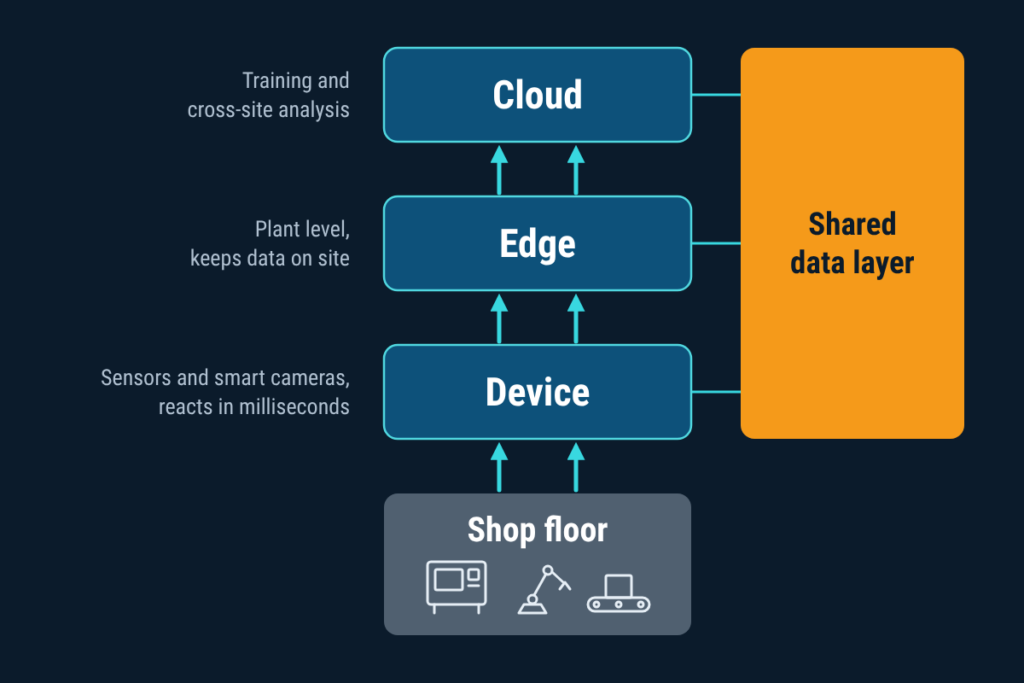
For these places to work together, they need the same data. A model trained in the cloud on data from plant A only works at the edge in plant B if the data there has the same structure and meaning. A central data layer provides exactly that: it connects devices in their native protocols such as OPC UA, Modbus or MQTT, adds context and makes the data available to every application in a consistent format. In many factories, this layer is built as a Unified Namespace, the shared nervous system through which every machine, line and model exchanges its data.
Every AIoT application follows the same cycle, whether it monitors a pump or inspects parts with a camera.
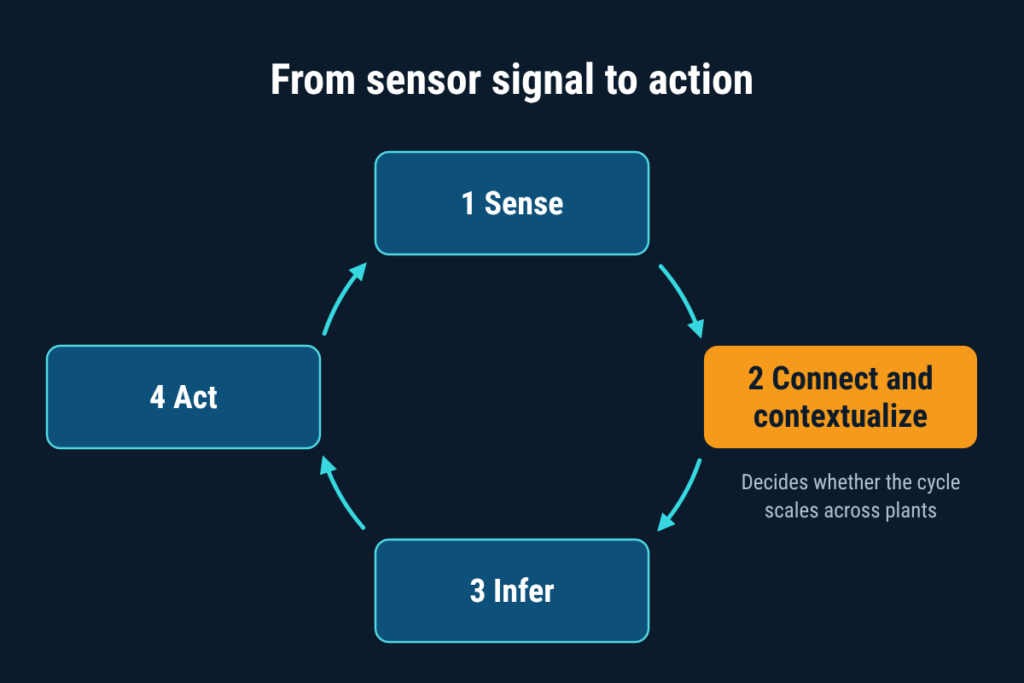
The second step decides whether the cycle can be repeated across plants. When it is solved separately for each machine, every AIoT use case remains a one-off. When it is solved once in a shared data layer, the next device and the next plant can use the same models.
A bearing that starts to wear, a temperature drifting out of tolerance or rising energy consumption: with AIoT, such changes are detected while there is still time to act. The effect grows with every device that delivers its data in the same structure, because models, dashboards and alerts can then be reused across machines and plants.
AIoT projects rarely fail because of the algorithm. The hurdles lie in the variety of devices, in operating many models at once and in security.
| Challenge | Solution |
|---|---|
| Many device types, protocols and vendors in a brownfield plant | A connectivity layer with ready-made protocol connectors that reads the devices without changing them |
| Data without a uniform structure or context | A shared data model with naming conventions for assets, lines and sites |
| Models that only work on the machine they were trained on | Training on contextualized data from several machines and the same data structure at every site |
| Operating and updating models on many edge devices | Central management, versioned configuration as code and MLOps processes |
| Unreliable network connections in the plant | Processing at the edge and buffering of data until the connection is restored |
| More connected devices mean a larger attack surface | Encrypted communication, certificate-based authentication and role-based access down to individual data points |

AIoT works with live data from every connected machine. Twelve questions across four areas show you where your factory stands on the path to Industrial AI and what your next step should be, whether you are just getting started or planning to scale.
You are currently viewing a placeholder content from HubSpot. To access the actual content, click the button below. Please note that doing so will share data with third-party providers.
More InformationVibration, temperature and current sensors on motors, pumps and spindles deliver data continuously. A model at the edge detects changes that precede a failure and reports them early enough to plan maintenance. See Predictive Maintenance.
Cameras check parts during production, and an edge model classifies defects in real time. Linking each image with process data such as machine parameters, material batch and order makes it possible to trace a defect back to its cause.
Meters and machine data show where and when energy is consumed. AI detects unusual consumption, forecasts peak loads and suggests better operating points. Learn more about energy management.
Data from controllers, MES and sensors flows into models that detect bottlenecks and micro-stoppages. This makes availability, performance and quality visible line by line. See OEE.
Older machines without modern interfaces can become part of an AIoT setup via their controller or additional sensors. The machine itself stays as it is, and a connectivity layer makes its signals usable for AI in the same format as the data from new equipment.
Driverless transport systems and mobile robots combine sensors and AI to navigate and coordinate material flows. In a dark factory, such systems take over large parts of production.
You can find more scenarios in our use cases and customer stories.
Every connected device extends the attack surface of a factory, and every AI model that can trigger actions raises the question of who is responsible for its decisions. A production-ready AIoT setup therefore needs clear rules:
How to structure the data foundation for AI in detail is described by our CTO Jasmin Skenderi in the expert article The Foundation of AI in Manufacturing: Getting Your Data Right.
Cybus Connectware is the data foundation between the devices on the shop floor and the AI applications that use their data. It reads machines, controllers and sensors in their native protocols, adds context and distributes the data in real time to edge applications, cloud platforms and AI models. Existing machines and PLC programs stay untouched, and production data remains under your control, on premises or in the cloud of your choice.
The built-in broker is called CybusMQ and comes as part of Cybus Connectware. How Cybus Connectware prepares production data for AI is described on the product page.
trusted by











AIoT stands for Artificial Intelligence of Things. It describes the combination of artificial intelligence with the Internet of Things: connected devices collect data, and AI evaluates it and turns it into decisions or actions.
IoT connects devices and collects their data. AIoT adds the ability to analyze this data automatically, detect patterns and react to them. This allows machines and systems to predict failures or adjust processes on their own.
Edge AI describes where an AI model runs: on the device or close to it. AIoT is the broader concept of combining connected devices with AI, and its models can run on the device, at the edge or in the cloud. Many AIoT applications in manufacturing use edge AI.
Industrial AI covers all uses of AI in production, including forecasts, planning, assistants and agents. AIoT describes the part in which AI works directly with data from connected machines, sensors and devices.
Typical examples are predictive maintenance on motors and pumps, visual quality inspection with cameras, energy optimization, OEE analysis, autonomous mobile robots and driverless transport systems.
AIoT devices are sensors, cameras, controllers, industrial PCs and machines that capture data and either run AI models themselves or deliver their data to models at the edge or in the cloud.
An AIoT platform is software that connects devices, manages their data and provides it to AI models, often combined with tools for deploying and monitoring models. In manufacturing, its core is a data foundation that delivers machine data in real time and with context. More on Industrial IoT platforms.
Yes. Older machines can be connected via their controller or with additional sensors without changing the machine itself. A connectivity layer translates their data into the same format as the data from modern devices.
AIoT is as secure as the communication and access rules behind it. Encrypted connections, certificate-based authentication, fine-grained permissions and controlled model updates keep connected devices and their data protected.
Start with a concrete use case, access to the data of the relevant machines and a data foundation that provides this data in real time with context. Many manufacturers begin with a pilot on one line and roll it out to further lines and plants from there.
You need to load content from reCAPTCHA to submit the form. Please note that doing so will share data with third-party providers.
More InformationYou are currently viewing a placeholder content from Turnstile. To access the actual content, click the button below. Please note that doing so will share data with third-party providers.
More InformationYou are currently viewing a placeholder content from Facebook. To access the actual content, click the button below. Please note that doing so will share data with third-party providers.
More InformationYou are currently viewing a placeholder content from Hubspot Embedded Content. To access the actual content, click the button below. Please note that doing so will share data with third-party providers.
More InformationYou are currently viewing a placeholder content from HubSpot. To access the actual content, click the button below. Please note that doing so will share data with third-party providers.
More InformationYou are currently viewing a placeholder content from Hubspot Meetings. To access the actual content, click the button below. Please note that doing so will share data with third-party providers.
More InformationYou are currently viewing a placeholder content from Instagram. To access the actual content, click the button below. Please note that doing so will share data with third-party providers.
More InformationYou are currently viewing a placeholder content from reCAPTCHA. To access the actual content, click the button below. Please note that doing so will share data with third-party providers.
More InformationYou are currently viewing a placeholder content from X. To access the actual content, click the button below. Please note that doing so will share data with third-party providers.
More Information