In short: The Industrial Internet of Things (IIoT), also called Industrial IoT, is the networking of machines, sensors, controllers and production systems so that their data can be collected, shared and used across a company. It applies the idea of the Internet of Things to industrial environments such as factories, energy plants and logistics. The goal of IIoT is a continuous flow of data from the shop floor to the applications that plan, control and improve production, from the dashboard on the line to MES, ERP and AI.
Jump to: IIoT vs. IoT · Origin · The problem · How it works · IT/OT · Benefits · Examples · Challenges · Security · IIoT and AI · Market · FAQ
The Internet of Things (IoT) describes physical objects that are connected to a network and exchange data, such as smart thermostats, fitness trackers or connected cars. The Industrial Internet of Things applies the same principle to production and infrastructure. The technology overlaps to a large degree, yet the conditions under which it has to work differ considerably. When a smart speaker loses its connection, the user restarts it. When a press line loses its data connection, production can stop, tools can be damaged and people can be put at risk.
The table summarizes the main differences between consumer IoT and Industrial IoT.
| Consumer IoT | Industrial IoT (IIoT) | |
|---|---|---|
| Typical devices | Smartphones, wearables, smart home devices, connected cars | PLCs, CNC machines, robots, drives, sensors, energy meters |
| Lifetime of the equipment | A few years, devices are replaced often | Often decades, new and old machines run side by side |
| Communication | Wi-Fi, Bluetooth, cellular, cloud APIs | Industrial protocols such as OPC UA, Modbus, S7 or PROFINET, plus MQTT for distribution |
| Consequences of a failure | Inconvenience for a single user | Downtime, scrap and safety risks for people and machines |
| Timing | A delay of seconds is usually fine | Near real time, in control loops down to milliseconds |
| Data volume | Small amounts per device | Continuous streams from thousands of signals per plant |
| Security focus | Personal data and privacy | Availability, integrity and protection of production know-how |
| Data ownership | Devices belong to individuals, data often stays with the vendor | Manufacturers need control over their data and over who may use it |
The term grew out of two developments that ran in parallel. In Germany, the Industrie 4.0 initiative was presented at Hannover Messe in 2011 and described the factory of the future as a network of cyber-physical systems. In the US, General Electric published a report on the “Industrial Internet” in November 2012, which described the combination of industrial machines, sensors and analytics. In March 2014, AT&T, Cisco, GE, IBM and Intel founded the Industrial Internet Consortium, which has been operating as the Industry IoT Consortium since 2021.
Today, Industrial IoT is the more technical of the terms, while Industry 4.0 describes the overall transformation of production. In practice, both are often used interchangeably. The most important related terms at a glance:
Most factories have been producing data for a long time. Controllers know cycle times, temperatures and error codes, energy meters measure consumption and test benches record quality values. Collecting this data is rarely the hard part. The difficulty begins when the data has to leave the machine: every vendor speaks its own protocol, older controllers were never designed to share data and each new application usually brings its own interface to the shop floor.
Over the years, this creates a dense web of point-to-point connections. A dashboard for one line works, and a predictive maintenance pilot on three machines works as well. As soon as the use case is supposed to run on the next line or in another plant, the work starts again with new interfaces, new mappings and new agreements between IT and production. The automation pyramid, with its rigid levels from the field device up to ERP, reinforces this pattern.
Current figures show how widespread the gap is. According to a Bitkom study from July 2026, 97 percent of German industrial companies with 100 or more employees use at least one Industry 4.0 application, and 45 percent already work with IoT platforms. At the same time, 57 percent of the companies that use digital twins name missing data as a hurdle. Industrial IoT therefore stands or falls with one question: does the data from the shop floor arrive in a form that many applications can use?
An IIoT architecture can be described in four building blocks. Each of them is a discipline of its own, and the overall system is only as strong as the connections between them.
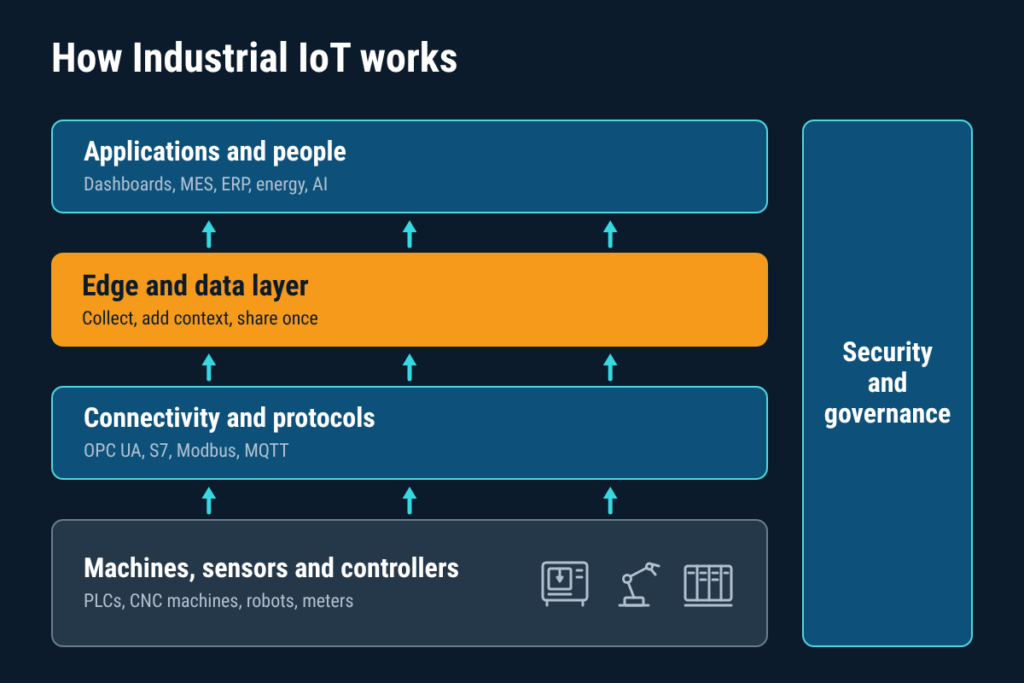
At the bottom are the physical assets: PLCs, CNC machines, robots, drives, sensors and meters. Many of them have been running for years and will continue to do so for a long time. Retrofit sensors add measurements where a machine offers none, for example vibration or energy consumption.
The data has to be read in the languages of the shop floor. OPC UA has established itself as the standard for describing machine data with semantics. Alongside it, protocols such as Siemens S7, Modbus or Heidenhain DNC remain widespread. For distributing the data, the lightweight MQTT protocol has become common, usually with an MQTT broker as the central hub.
Close to the machines, edge systems collect the data, filter it, add context and translate it into a common format. A shared data layer or Unified Namespace then ensures that each value exists only once and can be subscribed to by every authorized application. The software that bundles these tasks is called an Industrial IoT platform. Its architecture is explained in five layers on the dedicated page.
At the top are the applications that create value from the data: dashboards for shift managers, MES and ERP, energy management, quality analytics, maintenance software and, increasingly, AI models. People remain part of the system. They interpret the information, make decisions and feed their experience back into the processes.
The more cleanly the second and third building blocks are solved, the faster new applications can be added on top. That is why the architecture in the middle has more influence on the success of an IIoT strategy than the choice of any single application.
Industrial IoT brings together two disciplines with different priorities. Operational technology (OT) is responsible for the physical process. Its top priorities are availability, safety and stability, and changes are made carefully, often only during planned downtime. Information technology (IT) works with short release cycles, standardized interfaces and central security policies. Both perspectives are justified.
Successful IIoT projects therefore respect what already exists on the shop floor. Machines, controllers and PLC programs stay as they are, and data is read through an additional layer that does not interfere with the control logic. This keeps the risk for production low and gives IT standardized access to the data. In this setup, production managers can also evaluate data themselves, without having to submit a request to IT for every new question.
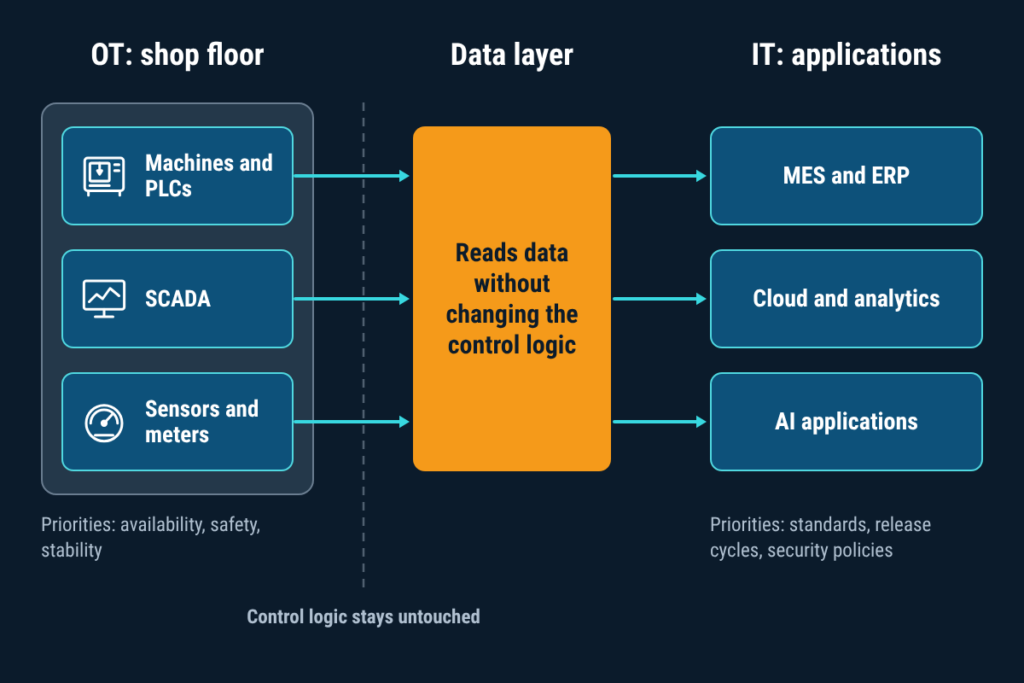
How this can look in a new plant is described in our article on building a smart factory with IT/OT integration and event-driven architecture.
The benefits of IIoT come from the use cases that are built on it. They share one prerequisite: data that is available in near real time, comparable across machines and trustworthy.
How Industrial IoT looks in practice depends on the industry, the age of the machine park and the goal. The following examples from Cybus customers show the range.
At the Porsche plants in Stuttgart-Zuffenhausen and Leipzig, a common data infrastructure with universal cloud connectivity has been implemented. It provides a technology-neutral framework in which many digital solutions along the manufacturing chain can be developed in a compatible way. Read the Porsche success story
GRIMME, a manufacturer of agricultural machinery with 3,100 employees and seven production sites, wanted to reduce machine downtimes caused by a lack of insight into machine status. The machines were connected via a Factory Data Hub, and their status is now visualized on dashboards. The data infrastructure was in place in less than two weeks and serves as the basis for further use cases. Read the GRIMME success story
For the new greenfield plant of Green Teuto Systemtechnik (GTS) in Ibbenbüren, Germany, the KRONE Group relies on an event-driven data architecture. Together with NTT DATA, Cybus supported the architectural concept and its implementation, with a central Factory Data Hub that connects production with the IT systems. Read the KRONE case study
Deutsche Nickel GmbH, one of the largest manufacturers of nickel and nickel alloy wire and rod, digitalizes its shop floor along a defined roadmap with projects in production, maintenance and quality assurance. The first use case went live after six weeks. Read the Deutsche Nickel success story
A global manufacturer of clamping and automation technology with eight production sites connected 120 machines to record their energy consumption in real time, across controllers that communicate via OPC UA, S7 and Heidenhain, among others. All stakeholders now have access to the energy data, cleaning cycles were reduced and efficiency rose by 9 percent. Read the case study
A food and beverage manufacturer with 14 production sites needed detailed energy data to pass the audits required for government funding. Energy meters and the building management system were integrated via Modbus TCP and a standardized interface, and the data is passed on to monitoring systems and databases. The audits were successful and secured the funding. Read the case study
The most common hurdles in IIoT projects rarely concern the technology of a single machine. They arise at the interfaces between systems, teams and plants.
| Challenge | Why it matters | How to address it |
|---|---|---|
| Heterogeneous machine park | Dozens of protocols and controller generations meet in a single plant | Protocol adapters that read existing controllers without changes to the PLC program |
| Point-to-point integrations | Every new application needs new interfaces, so costs rise with each use case | A central data layer or Unified Namespace that applications subscribe to |
| Missing context | Raw values without unit, asset or order reference cannot be compared | A shared data model, for example based on ISA-95, that is defined once and reused |
| OT security | Every new connection can become an attack path into production | Network segmentation, encrypted connections and fine-grained permissions in line with IEC 62443 |
| Scaling beyond the pilot | Solutions built by hand for one line cannot be copied to the next | Configurations described as code, versioned and rolled out across plants with Infrastructure as Code |
| Skills and responsibilities | OT and IT teams have different priorities and vocabularies | Joint teams, clear data ownership and tools that production staff can use themselves |
| Vendor lock-in | Data held in proprietary systems limits future decisions | Open standards and a vendor-neutral data foundation that the company controls |
Every connection that makes production data available also has to be protected, and the threat is real. According to the Dragos OT Cybersecurity Year in Review 2026, manufacturing accounted for more than two thirds of all ransomware victims among industrial organizations in 2025. Dragos also reports that organizations with comprehensive visibility into their OT networks contained such incidents in an average of five days, compared with an industry average of 42 days.
Good IIoT security therefore starts with the architecture. The established reference is the IEC 62443 series of standards for the security of industrial automation and control systems. In practice, these principles have proven themselves:
Governance goes beyond security. It defines who owns which data, how assets and signals are named and who may approve changes. How a lean security architecture for IIoT can be implemented is described in our article on DIN SPEC 27070.
Many manufacturers are currently investing in AI for production, from visual quality inspection to process optimization and AI agents. These applications depend on the data that Industrial IoT provides. A model can only be as good as the data it is trained and operated with, and an AI application that works on one line will only scale if the data from the other lines is available in the same structure.
In this picture, IIoT is the nervous system of the factory: it picks up the signals from the shop floor and passes them on to wherever they are needed. AI is one of the applications that uses these signals to recognize patterns and support decisions. The combination of both is known as AIoT (Artificial Intelligence of Things).
The number of connected devices keeps growing. According to IoT Analytics, there were 21.1 billion connected IoT devices worldwide at the end of 2025, 13 percent more than a year earlier. Enterprise IoT spending grew by 13 percent to 324 billion US dollars in 2025, and the analysts forecast growth of 14 percent for 2026.
At the same time, the focus is shifting. After years in which connecting machines was the main topic, the question now is how the data can be used across sites and for increasingly autonomous, AI-supported operations. For manufacturers, this means that the data foundation they build today determines which applications they can adopt in the coming years.
Cybus Connectware is an Industrial IoT platform that creates the data foundation for manufacturing companies. It connects machines and systems vendor-neutrally, structures their data and makes it available to every application, on premises, at the edge or in the cloud. Manufacturers such as Porsche, KRONE and GRIMME use it to take their IIoT use cases from the first line to many plants.
The built-in broker is called CybusMQ and comes as part of Cybus Connectware. As the data foundation for Industrial AI, Cybus Connectware also provides the consistent, current data that AI applications need.
trusted by








IIoT stands for Industrial Internet of Things. The term describes the networking of machines, sensors and systems in industry so that their data can be collected and used. Industrial IoT and IIoT mean the same thing.
IIoT means that the machines in a factory are connected and share their data with software that evaluates it. A shift manager can then see on a screen which machine is running, which is at a standstill and why, without walking through the hall.
IoT covers all connected devices, including consumer products such as smartwatches or smart home devices. IIoT refers to industrial environments, where machines run for decades, industrial protocols are used and failures lead to downtime or safety risks.
A typical example is energy monitoring: energy meters on the machines send their consumption values to a central system, where they become visible for production, maintenance and controlling. Other examples are condition monitoring of motors, OEE dashboards across plants and the traceability of parts in automotive manufacturing.
The terms are closely related. Industry 4.0 describes the overall vision of connected, adaptive production. IIoT is the technical basis that makes this vision possible by connecting machines and systems and making their data usable.
An IIoT platform is the software that connects machines and sensors with IT applications, adds context to the data and distributes it. More on the Industrial IoT platform page.
On the shop floor, OPC UA, Modbus, Siemens S7, PROFINET and many proprietary protocols are common. For distributing data to many applications, MQTT has become established. An IIoT architecture usually combines several of them.
IIoT can be operated securely if security is part of the architecture from the start: separate network zones, encrypted connections, certificate-based authentication and fine-grained permissions. The IEC 62443 series of standards provides a framework for this.
SCADA systems monitor and control processes within a plant or line. IIoT makes data from many sources available to many applications across sites, from MES to the cloud and AI. In many plants, both exist side by side. More in our article Industrial IoT vs. SCADA.
Start with a concrete use case that has a measurable benefit, such as transparency about machine downtime or energy consumption, and build it on a data foundation that can be extended to further machines and plants. A step-by-step guide is available on our page about introducing an Industrial IoT platform.
You need to load content from reCAPTCHA to submit the form. Please note that doing so will share data with third-party providers.
More InformationYou are currently viewing a placeholder content from Turnstile. To access the actual content, click the button below. Please note that doing so will share data with third-party providers.
More InformationYou are currently viewing a placeholder content from Facebook. To access the actual content, click the button below. Please note that doing so will share data with third-party providers.
More InformationYou are currently viewing a placeholder content from Hubspot Embedded Content. To access the actual content, click the button below. Please note that doing so will share data with third-party providers.
More InformationYou are currently viewing a placeholder content from HubSpot. To access the actual content, click the button below. Please note that doing so will share data with third-party providers.
More InformationYou are currently viewing a placeholder content from Hubspot Meetings. To access the actual content, click the button below. Please note that doing so will share data with third-party providers.
More InformationYou are currently viewing a placeholder content from Instagram. To access the actual content, click the button below. Please note that doing so will share data with third-party providers.
More InformationYou are currently viewing a placeholder content from reCAPTCHA. To access the actual content, click the button below. Please note that doing so will share data with third-party providers.
More InformationYou are currently viewing a placeholder content from X. To access the actual content, click the button below. Please note that doing so will share data with third-party providers.
More Information